OPCML Polyklonaler Antikörper
OPCML Polyklonal Antikörper für WB, Indirect ELISA
Wirt / Isotyp
Kaninchen / IgG
Getestete Reaktivität
human, Maus, Ratte
Anwendung
WB, Indirect ELISA
Konjugation
Unkonjugiert
Kat-Nr. : 17962-1-PBS
Synonyme
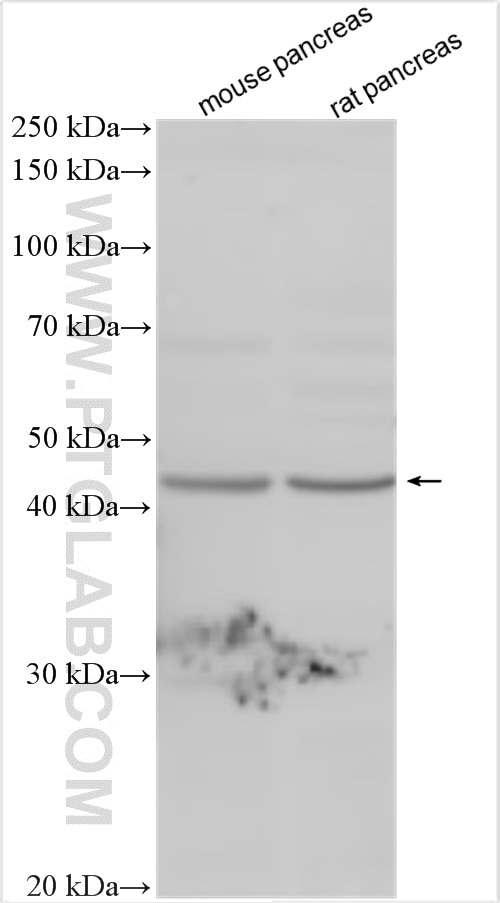
Geprüfte Anwendungen
Produktinformation
17962-1-PBS bindet in WB, Indirect ELISA OPCML und zeigt Reaktivität mit human, Maus, Ratten
| Getestete Reaktivität | human, Maus, Ratte |
| Wirt / Isotyp | Kaninchen / IgG |
| Klonalität | Polyklonal |
| Typ | Antikörper |
| Immunogen | OPCML fusion protein Ag12560 |
| Vollständiger Name | opioid binding protein/cell adhesion molecule-like |
| Berechnetes Molekulargewicht | 345 aa, 38 kDa |
| Beobachtetes Molekulargewicht | 45 kDa |
| GenBank-Zugangsnummer | BC074773 |
| Gene symbol | OPCML |
| Gene ID (NCBI) | 4978 |
| Konjugation | Unkonjugiert |
| Form | Liquid |
| Reinigungsmethode | Antigen-Affinitätsreinigung |
| Lagerungspuffer | PBS only |
| Lagerungsbedingungen | Store at -80°C. 20ul Größen enthalten 0,1% BSA. |
Hintergrundinformationen
OPCML, also called opioid-binding cell adhesion molecule (OBCAM), belongs to the IgLON limbic system-associated membrane protein (LSAMP, OPCML/OBCAM, neurotrimin) family of IgG domain containing glycosylphosphatidylinositol-anchored cell adhesion molecules. Originally isolated from brain, OPCMLis also expressed in stomach, ovary, heart, placenta, testis, kidney, liver, pancreas and colon. OPCML has been identified as a tumour suppressor, which inhibited tumor growth in some cancers including ovarian cancer, lung cancer and prostate cancer (PMID: 19176311; 28407749).


