OSBPL5 Polyklonaler Antikörper
OSBPL5 Polyklonal Antikörper für WB, ELISA
Wirt / Isotyp
Kaninchen / IgG
Getestete Reaktivität
human, Maus, Ratte
Anwendung
WB, ELISA
Konjugation
Unkonjugiert
Kat-Nr. : 27870-1-AP
Synonyme
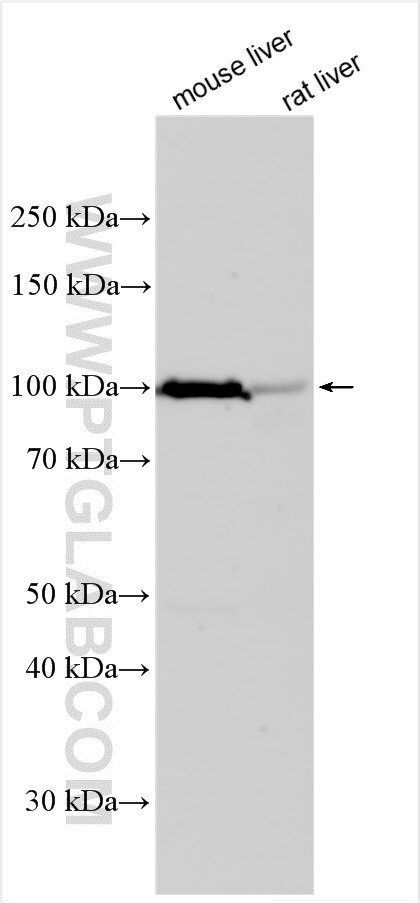
Geprüfte Anwendungen
| Erfolgreiche Detektion in WB | Mauslebergewebe, Rattenlebergewebe |
Empfohlene Verdünnung
| Anwendung | Verdünnung |
|---|---|
| Western Blot (WB) | WB : 1:2000-1:12000 |
| It is recommended that this reagent should be titrated in each testing system to obtain optimal results. | |
| Sample-dependent, check data in validation data gallery | |
Produktinformation
27870-1-AP bindet in WB, ELISA OSBPL5 und zeigt Reaktivität mit human, Maus, Ratten
| Getestete Reaktivität | human, Maus, Ratte |
| Wirt / Isotyp | Kaninchen / IgG |
| Klonalität | Polyklonal |
| Typ | Antikörper |
| Immunogen | OSBPL5 fusion protein Ag27304 |
| Vollständiger Name | oxysterol binding protein-like 5 |
| Berechnetes Molekulargewicht | 811 aa, 91 kDa |
| Beobachtetes Molekulargewicht | 100 kDa |
| GenBank-Zugangsnummer | BC032646 |
| Gene symbol | OSBPL5 |
| Gene ID (NCBI) | 114879 |
| Konjugation | Unkonjugiert |
| Form | Liquid |
| Reinigungsmethode | Antigen-Affinitätsreinigung |
| Lagerungspuffer | PBS with 0.02% sodium azide and 50% glycerol |
| Lagerungsbedingungen | Bei -20°C lagern. Nach dem Versand ein Jahr lang stabil Aliquotieren ist bei -20oC Lagerung nicht notwendig. 20ul Größen enthalten 0,1% BSA. |
Hintergrundinformationen
OSBPL5, also known as oxysterol binding protein like 5, is a protein-coding gene in humans. It is a member of the oxysterol-binding protein (OSBP) family, which consists of intracellular lipid receptors that play a crucial role in maintaining cholesterol balance in the body. It is expressed ubiquitously in various tissues, including the spleen and endometrium. OSBPL5 is classified as a plasma protein and transporter, with a predicted subcellular location in the membrane and intracellular compartments. The protein has been implicated in several biological processes and is involved in the transport of lipids and other molecules between organelles. In terms of disease association, OSBPL5 has been linked to conditions such as Lenz-Majewski hyperostotic dwarfism. Additionally, the OSBPL family of proteins, including OSBPL5, has been suggested to play a role in cancer development, although specific roles in different types of cancer are still being investigated (PMID: 36918840). The molecular weight of OSBPL5 is 98 kDa.
Protokolle
| PRODUKTSPEZIFISCHE PROTOKOLLE | |
|---|---|
| WB protocol for OSBPL5 antibody 27870-1-AP | Protokoll herunterladen |
| STANDARD-PROTOKOLLE | |
|---|---|
| Klicken Sie hier, um unsere Standardprotokolle anzuzeigen |

