PAK3 Polyklonaler Antikörper
PAK3 Polyklonal Antikörper für WB, Indirect ELISA
Wirt / Isotyp
Kaninchen / IgG
Getestete Reaktivität
Hausschwein, human, Maus, Ratte
Anwendung
WB, Indirect ELISA
Konjugation
Unkonjugiert
Kat-Nr. : 32848-1-PBS
Synonyme
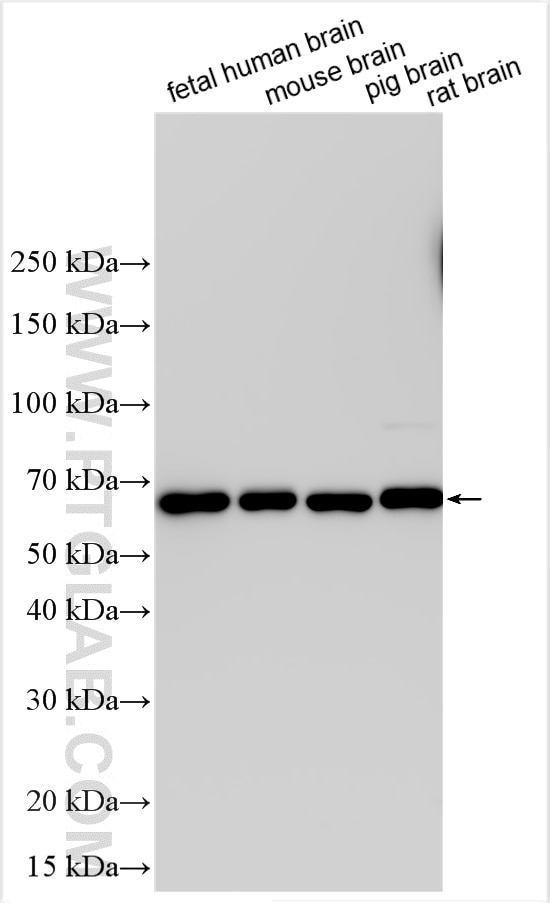
Geprüfte Anwendungen
Produktinformation
32848-1-PBS bindet in WB, Indirect ELISA PAK3 und zeigt Reaktivität mit Hausschwein, human, Maus, Ratten
| Getestete Reaktivität | Hausschwein, human, Maus, Ratte |
| Wirt / Isotyp | Kaninchen / IgG |
| Klonalität | Polyklonal |
| Typ | Antikörper |
| Immunogen | PAK3 fusion protein Ag38566 |
| Vollständiger Name | p21 protein (Cdc42/Rac)-activated kinase 3 |
| Berechnetes Molekulargewicht | 62kDa,559aa |
| Beobachtetes Molekulargewicht | 64 kDa |
| GenBank-Zugangsnummer | NM_001128173.2 |
| Gene symbol | PAK3 |
| Gene ID (NCBI) | 5063 |
| Konjugation | Unkonjugiert |
| Form | Liquid |
| Reinigungsmethode | Antigen-Affinitätsreinigung |
| Lagerungspuffer | PBS only |
| Lagerungsbedingungen | Store at -80°C. 20ul Größen enthalten 0,1% BSA. |
Hintergrundinformationen
PAK3, also known as p21-activated kinase 3, is a member of the PAK family of serine/threonine protein kinases, classified as Group I PAK kinases along with PAK1 and PAK2. PAK3 is predominantly expressed in neural cells, especially in regions such as the brain. PAK3 plays a crucial role in dendritic spine development and synaptic plasticity. PAK3 plays an important role in cell migration and morphology. It regulates dynamic changes in the actomyosin cytoskeleton, microtubules, and adhesion interactions with the microenvironment. In neurons and other cell types, PAK3 contributes to cell migration, neurite growth, and dendritic spine morphogenesis by participating in signaling cascades that control cell adhesion and cell motility. Mutations in PAK3 are associated with X-linked non-syndromic intellectual disability.


