PARP10 Rekombinanter Antikörper
PARP10 Rekombinant Antikörper für WB, Indirect ELISA
Wirt / Isotyp
Kaninchen / IgG
Getestete Reaktivität
human
Anwendung
Konjugation
Unkonjugiert
CloneNo.
250454D4
Kat-Nr. : 86096-1-PBS
Synonyme
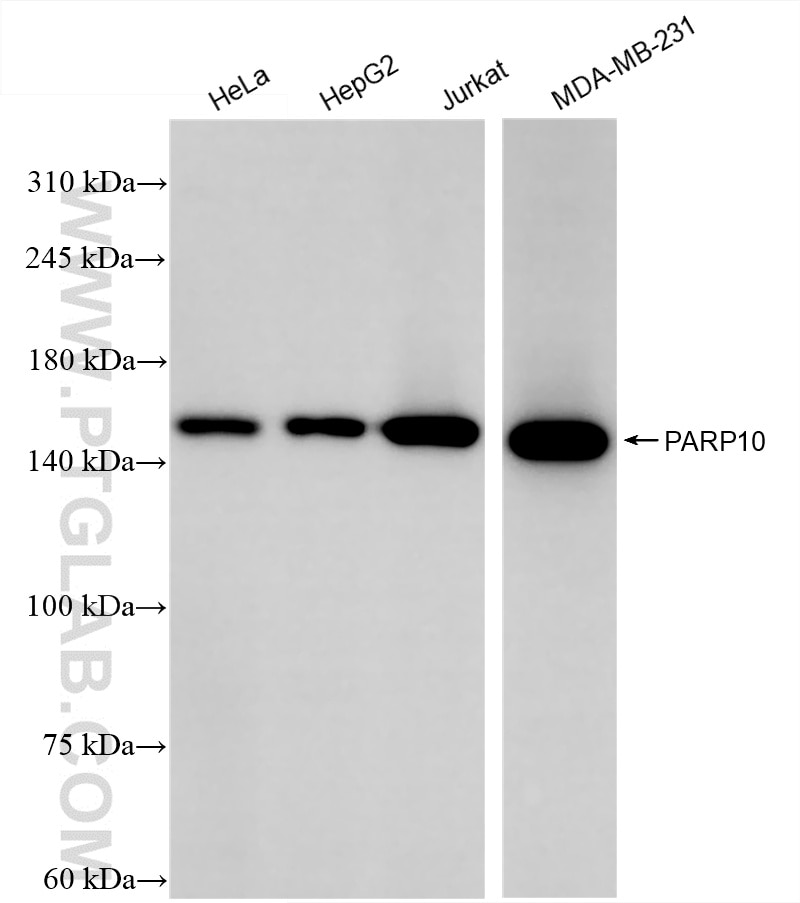
Geprüfte Anwendungen
Produktinformation
86096-1-PBS bindet in PARP10 und zeigt Reaktivität mit human
| Getestete Reaktivität | human |
| Wirt / Isotyp | Kaninchen / IgG |
| Klonalität | Rekombinant |
| Typ | Antikörper |
| Immunogen | PARP10 fusion protein Ag23457 |
| Vollständiger Name | poly (ADP-ribose) polymerase family, member 10 |
| Beobachtetes Molekulargewicht | 150 kDa |
| GenBank-Zugangsnummer | BC136542 |
| Gene symbol | PARP10 |
| Gene ID (NCBI) | 84875 |
| Konjugation | Unkonjugiert |
| Form | Liquid |
| Reinigungsmethode | Protein-A-Reinigung |
| Lagerungspuffer | PBS only |
| Lagerungsbedingungen | Store at -80°C. 20ul Größen enthalten 0,1% BSA. |
Hintergrundinformationen
PARP10 (Poly(ADP-ribose) polymerase family member 10) is a mono-ADP-ribosyltransferase that belongs to the PARP family. It regulates a variety of cellular functions, including gene transcription, DNA repair, and cell cycle control, by catalyzing ADP-ribosylation reactions. PARP10 is distributed in both the nucleus and cytoplasm, participating in the cellular response to DNA damage. In particular, its expression level significantly increases in response to UV-induced DNA damage. Additionally, PARP10 plays a crucial role in the antiviral response, being highly upregulated by interferon (IFN) to inhibit the replication of certain viruses and block protein translation during viral replication. PARP10 is also involved in immune regulation, interacting with NEMO to block the NF-κB signaling pathway and the production of pro-inflammatory cytokines.


