PLVAP Rekombinanter Antikörper
PLVAP Rekombinant Antikörper für FC
Wirt / Isotyp
Ratte / IgG2a
Getestete Reaktivität
Maus
Anwendung
FC
Konjugation
Unkonjugiert
CloneNo.
MECA-32
Kat-Nr. : 65664-1-PBS
Synonyme
Geprüfte Anwendungen
Produktinformation
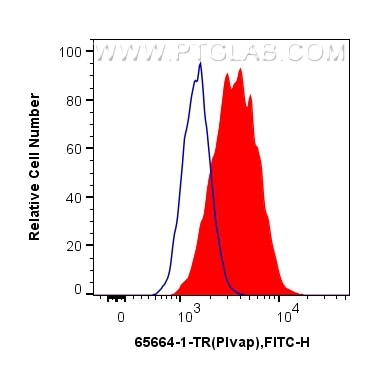
65664-1-PBS bindet in FC PLVAP und zeigt Reaktivität mit Maus
| Getestete Reaktivität | Maus |
| Wirt / Isotyp | Ratte / IgG2a |
| Klonalität | Rekombinant |
| Typ | Antikörper |
| Immunogen | k.A. |
| Vollständiger Name | plasmalemma vesicle associated protein |
| GenBank-Zugangsnummer | BC013517 |
| Gene symbol | Plvap |
| Gene ID (NCBI) | 84094 |
| Konjugation | Unkonjugiert |
| Form | Liquid |
| Reinigungsmethode | Protein-A-Reinigung |
| Lagerungspuffer | PBS only |
| Lagerungsbedingungen | Store at -80°C. |
Hintergrundinformationen
Plasmalemma vesicle-associated protein (PLVAP), also known as PV-1, PAL-E and MECA-32 antigen, is an endothelial cell-specific type II membrane N-glycosylated glycoprotein with a molecular weight of approximately 50-65 kDa, that forms homodimers in situ (PMID: 7626790; 30231925). The MECA-32 antibody, derived from rats immunized with murine lymph node stroma, shows high specificity for mouse endothelium in both embryonic and mature tissues (PMID: 2683264; 7626790). It recognizes most endothelial cells in the embryonic and in the adult mouse, with the exception of the brain, skeletal, and cardiac muscle, where the MECA-32 antigen has a more restricted distribution. In skeletal and cardiac muscle only small arterioles and venules express the MECA-32 antigen, while in the brain its expression is negatively correlated with the differentiation of the vasculature to form the blood brain barrier (PMID: 7626790).


