PSMB1 Monoklonaler Antikörper
PSMB1 Monoklonal Antikörper für FC (Intra)
Wirt / Isotyp
Maus / IgG1
Getestete Reaktivität
human
Anwendung
FC (Intra)
Konjugation
CoraLite®594 Fluorescent Dye
CloneNo.
1C7C5
Kat-Nr. : CL594-67847
Synonyme
Filter:
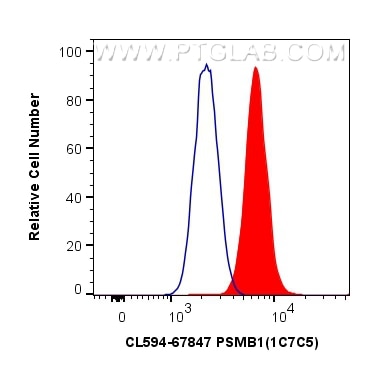
Geprüfte Anwendungen
| Erfolgreiche Detektion in FC (Intra) | HeLa-Zellen |
Empfohlene Verdünnung
| Anwendung | Verdünnung |
|---|---|
| Durchflusszytometrie (FC) (INTRA) | FC (INTRA) : 0.40 ug per 10^6 cells in a 100 µl suspension |
| It is recommended that this reagent should be titrated in each testing system to obtain optimal results. | |
| Sample-dependent, check data in validation data gallery | |
Produktinformation
CL594-67847 bindet in FC (Intra) PSMB1 und zeigt Reaktivität mit human
| Getestete Reaktivität | human |
| Wirt / Isotyp | Maus / IgG1 |
| Klonalität | Monoklonal |
| Typ | Antikörper |
| Immunogen | PSMB1 fusion protein Ag30791 |
| Vollständiger Name | proteasome (prosome, macropain) subunit, beta type, 1 |
| Berechnetes Molekulargewicht | 241 aa, 26 kDa |
| Beobachtetes Molekulargewicht | 25 kDa |
| GenBank-Zugangsnummer | BC020807 |
| Gene symbol | PSMB1 |
| Gene ID (NCBI) | 5689 |
| Konjugation | CoraLite®594 Fluorescent Dye |
| Excitation/Emission maxima wavelengths | 588 nm / 604 nm |
| Form | Liquid |
| Reinigungsmethode | Protein-G-Reinigung |
| Lagerungspuffer | PBS with 50% glycerol, 0.05% Proclin300, 0.5% BSA |
| Lagerungsbedingungen | Bei -20°C lagern. Vor Licht schützen. Nach dem Versand ein Jahr stabil. Aliquotieren ist bei -20oC Lagerung nicht notwendig. 20ul Größen enthalten 0,1% BSA. |
Hintergrundinformationen
PSMB1(Proteasome subunit beta type-1) is also named as PSC5 and belongs to the peptidase T1B family. The proteasome is a multicatalytic proteinase complex which is characterized by its ability to cleave peptides with Arg, Phe, Tyr, Leu, and Glu adjacent to the leaving group at neutral or slightly basic pH. The gene encodes a 241 amino acid protein with a 28 amino acid propeptide and two glycosylation sites.
Protokolle
| PRODUKTSPEZIFISCHE PROTOKOLLE | |
|---|---|
| FC protocol for CL594 PSMB1 antibody CL594-67847 | Download protocol |
| STANDARD-PROTOKOLLE | |
|---|---|
| Klicken Sie hier, um unsere Standardprotokolle anzuzeigen |

