Phospho-AKT (Thr308) Rekombinanter Antikörper
Phospho-AKT (Thr308) Rekombinant Antikörper für WB, FC (Intra), Indirect ELISA
Wirt / Isotyp
Kaninchen / IgG
Getestete Reaktivität
human
Anwendung
WB, FC (Intra), Indirect ELISA
Konjugation
Unkonjugiert
CloneNo.
241845F1
Kat-Nr. : 81232-8-PBS
Synonyme
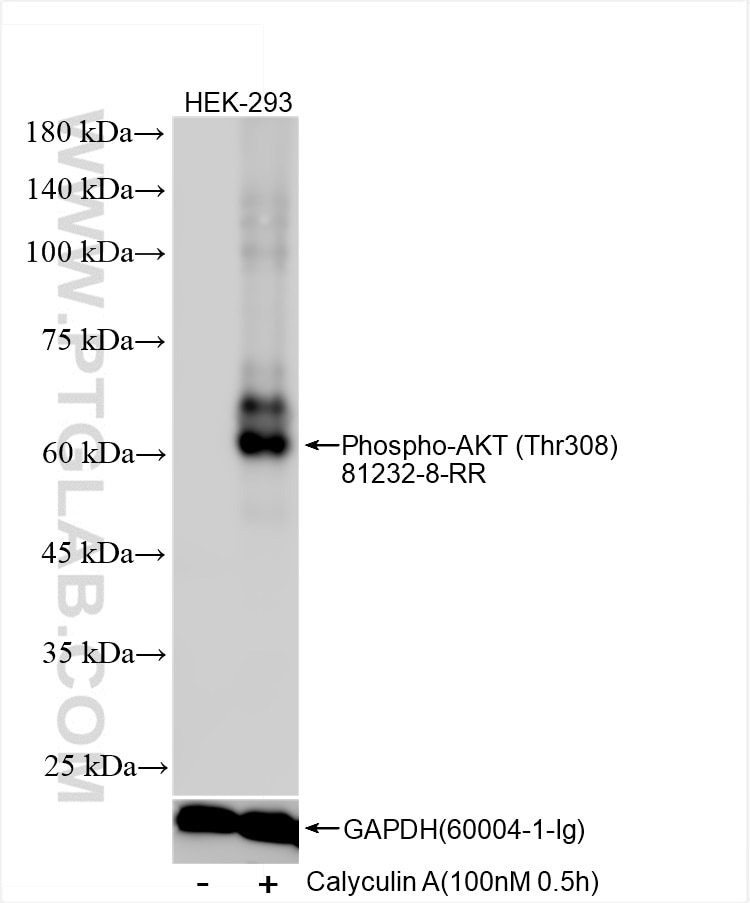
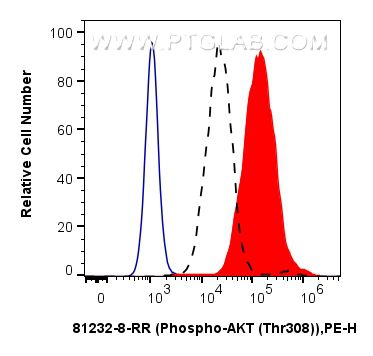
Geprüfte Anwendungen
Produktinformation
81232-8-PBS bindet in WB, FC (Intra), Indirect ELISA Phospho-AKT (Thr308) und zeigt Reaktivität mit human
| Getestete Reaktivität | human |
| Wirt / Isotyp | Kaninchen / IgG |
| Klonalität | Rekombinant |
| Typ | Antikörper |
| Immunogen | Peptid |
| Vollständiger Name | v-akt murine thymoma viral oncogene homolog 1 |
| Berechnetes Molekulargewicht | 56 kDa |
| Beobachtetes Molekulargewicht | 60 kDa |
| GenBank-Zugangsnummer | BC000479 |
| Gene symbol | AKT1 |
| Gene ID (NCBI) | 207 |
| Konjugation | Unkonjugiert |
| Form | Liquid |
| Reinigungsmethode | Protein A purfication |
| Lagerungspuffer | PBS only |
| Lagerungsbedingungen | Store at -80°C. 20ul Größen enthalten 0,1% BSA. |
Hintergrundinformationen
The serine-threonine kinase Akt, also known as protein kinase B (PKB), contributes to a broad range of cellular functions including cell survival, proliferation, gene expression and migration of cells of most lineages. AKT has a wide range of cellular substrates, and the oncogenicity of AKT arises from activation of both proliferative and anti-apoptotic signaling, thus making this kinase an attractive target for cancer therapy. Activation of mammalian AKT depends on its recruitment to the membrane through binding of phosphatidylinositol-3,4,5-trisphosphate (PIP3) to the PH domain of AKT, and subsequent phosphorylation at two key residues, Thr308 and Ser473, located at the catalytic domain and C-terminal regulatory domain, respectively. (PMID: 34740102, PMID: 29017516)


