Phospho-INSR (Tyr1150/1151)/IGF1R (Tyr1135/1136) Polyklonaler Antikörper
Phospho-INSR (Tyr1150/1151)/IGF1R (Tyr1135/1136) Polyklonal Antikörper für WB, ELISA
Wirt / Isotyp
Kaninchen / IgG
Getestete Reaktivität
human und mehr (1)
Anwendung
WB, ELISA
Konjugation
Unkonjugiert
Kat-Nr. : 31133-1-AP
Synonyme
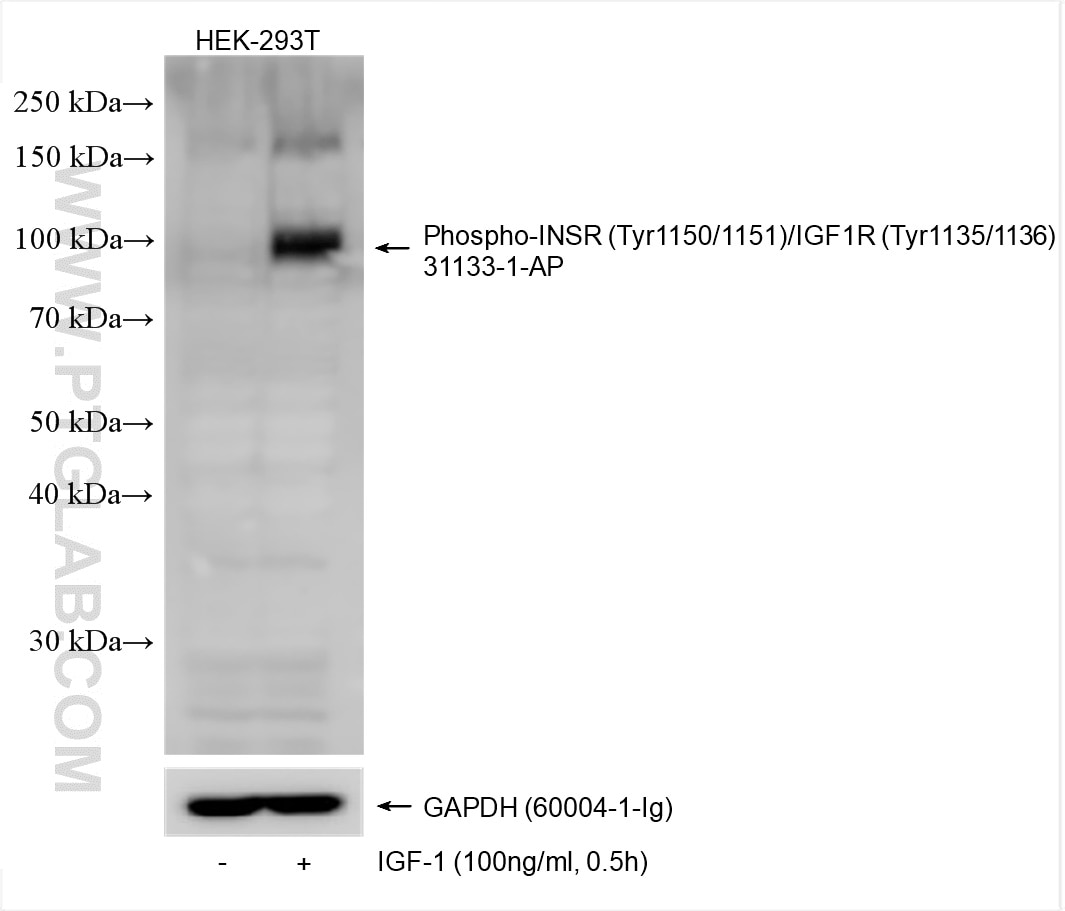
Geprüfte Anwendungen
| Erfolgreiche Detektion in WB | mit IGF-1 behandelte HEK-293T-Zellen |
Empfohlene Verdünnung
| Anwendung | Verdünnung |
|---|---|
| Western Blot (WB) | WB : 1:1000-1:4000 |
| It is recommended that this reagent should be titrated in each testing system to obtain optimal results. | |
| Sample-dependent, check data in validation data gallery | |
Veröffentlichte Anwendungen
| WB | See 1 publications below |
Produktinformation
31133-1-AP bindet in WB, ELISA Phospho-INSR (Tyr1150/1151)/IGF1R (Tyr1135/1136) und zeigt Reaktivität mit human
| Getestete Reaktivität | human |
| In Publikationen genannte Reaktivität | Maus |
| Wirt / Isotyp | Kaninchen / IgG |
| Klonalität | Polyklonal |
| Typ | Antikörper |
| Immunogen | Peptid |
| Vollständiger Name | INSR |
| Beobachtetes Molekulargewicht | 95 kDa |
| GenBank-Zugangsnummer | BC117172 |
| Gene symbol | INSR |
| Gene ID (NCBI) | 3643 |
| Konjugation | Unkonjugiert |
| Form | Liquid |
| Reinigungsmethode | Antigen-Affinitätsreinigung |
| Lagerungspuffer | PBS with 0.02% sodium azide and 50% glycerol |
| Lagerungsbedingungen | Bei -20°C lagern. Nach dem Versand ein Jahr lang stabil Aliquotieren ist bei -20oC Lagerung nicht notwendig. 20ul Größen enthalten 0,1% BSA. |
Hintergrundinformationen
Insulin binding to the insulin receptor (INSR) triggers sequential conformational changes and autophosphorylation of the receptor, followed by activation of a kinase signaling cascade that plays essential roles in a wide variety of biological processes. INSR belongs to a class of receptor tyrosine kinases (RTKs) that comprises 58 receptors in humans. The INSR shares a high structural homology with the IGF1R (84% similarity in the tyrosine kinase domain, 45-65% in the ligand-binding domain, and more than 50% in the overall amino acid sequence). In addition, ligand-dependent activation of the INSR and IGF1R activates almost identical downstream signaling cascades. Insulin binds to INSR in peripheral tissues, initiating receptor activation followed by intracellular signaling cascades. The first step in INSR activation is the autophosphorylation of intracellular tyrosine residues in the JM domain, kinase activation loop, and CT domain. Phosphorylation of three tyrosine residues (Tyr1146, Tyr1150, and Tyr1151, based on INSR isoform A numbering) located in the kinase activation loop plays a crucial role in kinase activity regulation. Insulin binding also induces INSR kinase-mediated phosphorylation of four tyrosine residues located in the JM (Tyr953 and Tyr960) and CT domain (Tyr1316 and Tyr1322). (PMID: 37779149,PMID:24434591
Protokolle
| PRODUKTSPEZIFISCHE PROTOKOLLE | |
|---|---|
| WB protocol for Phospho-INSR (Tyr1150/1151)/IGF1R (Tyr1135/1136) antibody 31133-1-AP | Protokoll herunterladen |
| STANDARD-PROTOKOLLE | |
|---|---|
| Klicken Sie hier, um unsere Standardprotokolle anzuzeigen |

