Phospho-LCK (Tyr505) Rekombinanter Antikörper
Phospho-LCK (Tyr505) Rekombinant Antikörper für WB, Indirect ELISA
Wirt / Isotyp
Kaninchen / IgG
Getestete Reaktivität
human
Anwendung
WB, Indirect ELISA
Konjugation
Unkonjugiert
CloneNo.
242450G6
Kat-Nr. : 85679-1-PBS
Synonyme
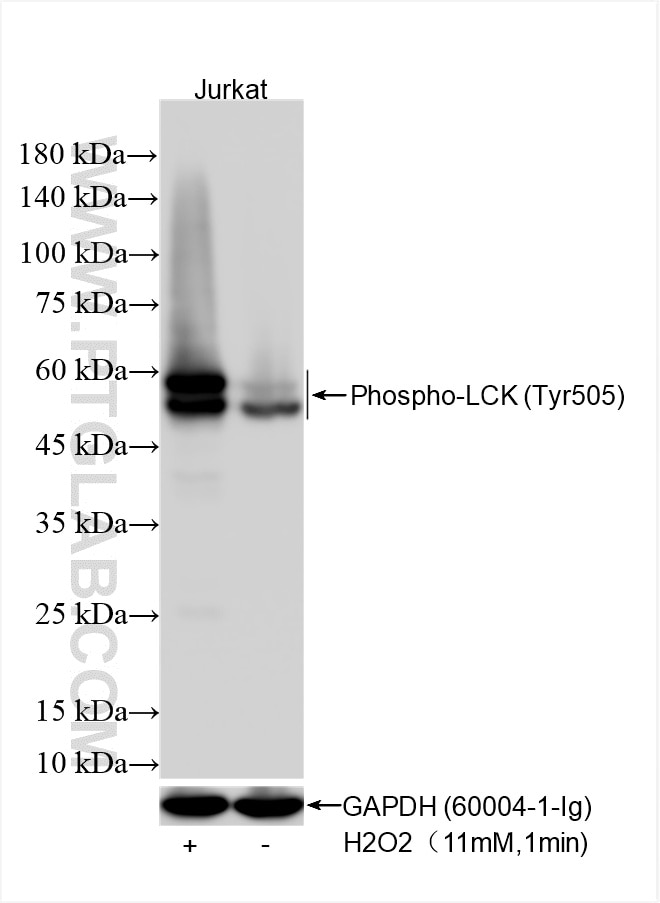
Geprüfte Anwendungen
Produktinformation
85679-1-PBS bindet in WB, Indirect ELISA Phospho-LCK (Tyr505) und zeigt Reaktivität mit human
| Getestete Reaktivität | human |
| Wirt / Isotyp | Kaninchen / IgG |
| Klonalität | Rekombinant |
| Typ | Antikörper |
| Immunogen | Peptid |
| Vollständiger Name | lymphocyte-specific protein tyrosine kinase |
| Berechnetes Molekulargewicht | 539 aa, 56 kDa |
| Beobachtetes Molekulargewicht | 56 kDa |
| GenBank-Zugangsnummer | BC013200 |
| Gene symbol | LCK |
| Gene ID (NCBI) | 3932 |
| Konjugation | Unkonjugiert |
| Form | Liquid |
| Reinigungsmethode | Protein-A-Reinigung |
| Lagerungspuffer | PBS only |
| Lagerungsbedingungen | Store at -80°C. 20ul Größen enthalten 0,1% BSA. |
Hintergrundinformationen
Lck is comprised of a SH3 domain, binding prolinerich regions, a SH2 domain, binding tyrosine-phosphorylated sequences, a kinase domain, a unique domain, and the negative regulatory tail. The kinase domain of Lck contains 2 important tyrosine residues. Tyr394 and Tyr505 represent the activating and inhibitory tyrosine residue, respectively. Therefore, Lck can exist in 4 distinct states of activity: an inactive state, a primed state, an active state, and a dually phosphorylated active state . Transitions between activity states are governed by phosphorylation at the Tyr394 and Tyr505 residues. When Tyr394 is dephosphorylated while Tyr505 is phosphorylated, Lck is in an inactive state. Lck becomes primed when Tyr505 is dephosphorylated and fully active after Tyr394 phosphorylation. In addition, there is a dually phosphorylated active form of Lck when both Tyr394 and Tyr505 residues are phosphorylated. (PMID: 32794043)


