Phospho-PAK1 (Ser144)/PAK2 (Ser141) Rekombinanter Antikörper
Phospho-PAK1 (Ser144)/PAK2 (Ser141) Rekombinant Antikörper für WB, Indirect ELISA
Wirt / Isotyp
Kaninchen / IgG
Getestete Reaktivität
human, Maus, Ratte
Anwendung
WB, Indirect ELISA
Konjugation
Unkonjugiert
CloneNo.
242123D12
Kat-Nr. : 85044-1-PBS
Synonyme
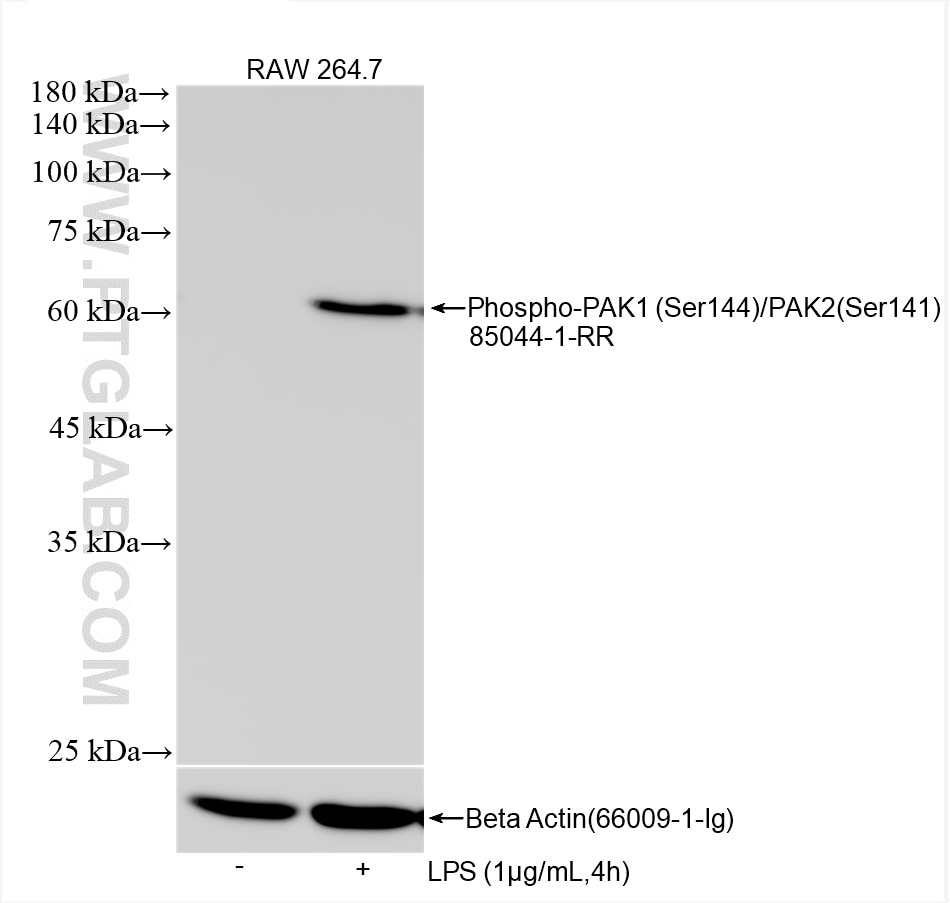
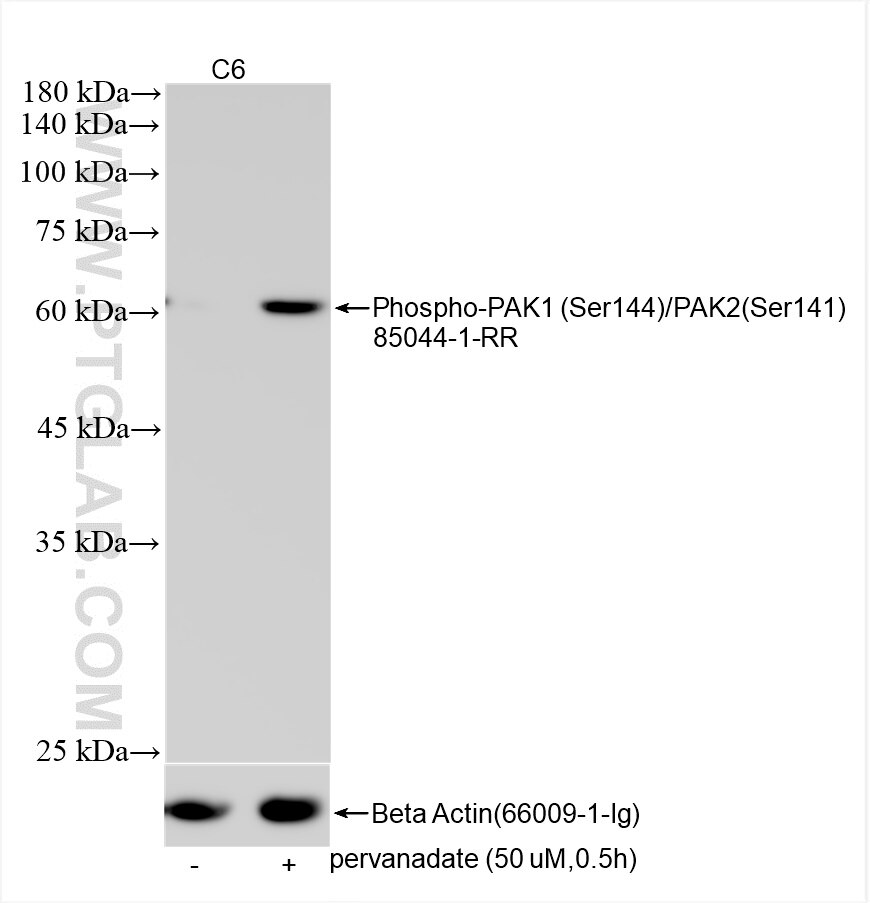
Geprüfte Anwendungen
Produktinformation
85044-1-PBS bindet in WB, Indirect ELISA Phospho-PAK1 (Ser144)/PAK2 (Ser141) und zeigt Reaktivität mit human, Maus, Ratten
| Getestete Reaktivität | human, Maus, Ratte |
| Wirt / Isotyp | Kaninchen / IgG |
| Klonalität | Rekombinant |
| Typ | Antikörper |
| Immunogen | Peptid |
| Vollständiger Name | p21 protein (Cdc42/Rac)-activated kinase 1 |
| Berechnetes Molekulargewicht | 553 aa, 62 kDa |
| Beobachtetes Molekulargewicht | 61 kDa |
| GenBank-Zugangsnummer | BC109299 |
| Gene symbol | PAK1 |
| Gene ID (NCBI) | 5058 |
| Konjugation | Unkonjugiert |
| Form | Liquid |
| Reinigungsmethode | Protein A purfication |
| Lagerungspuffer | PBS only |
| Lagerungsbedingungen | Store at -80°C. 20ul Größen enthalten 0,1% BSA. |
Hintergrundinformationen
The human PAK family is divided into the group I (PAK1 to PAK3) and group II (PAK4 to PAK6). Group I PAK share some domains that are not present in the group II members. In particular, the autoinhibitory domain (AID) is important for regulation of the kinase activity of the group I family members. Autophosphorylation at PAK1 Ser144, or at the equivalent sites for the other PAK, stabilizes the open conformation and sustains high kinase activity. Mutation of tyrosines 131 or 429 is associated with reduced dimerization and enhanced kinase activity. (PMID: 31748572)


