Phospho-PRKD1 (Ser916) Rekombinanter Antikörper
Phospho-PRKD1 (Ser916) Rekombinant Antikörper für WB, Indirect ELISA
Wirt / Isotyp
Kaninchen / IgG
Getestete Reaktivität
human, Maus
Anwendung
WB, Indirect ELISA
Konjugation
Unkonjugiert
CloneNo.
241786A11
Kat-Nr. : 80080-2-PBS
Synonyme
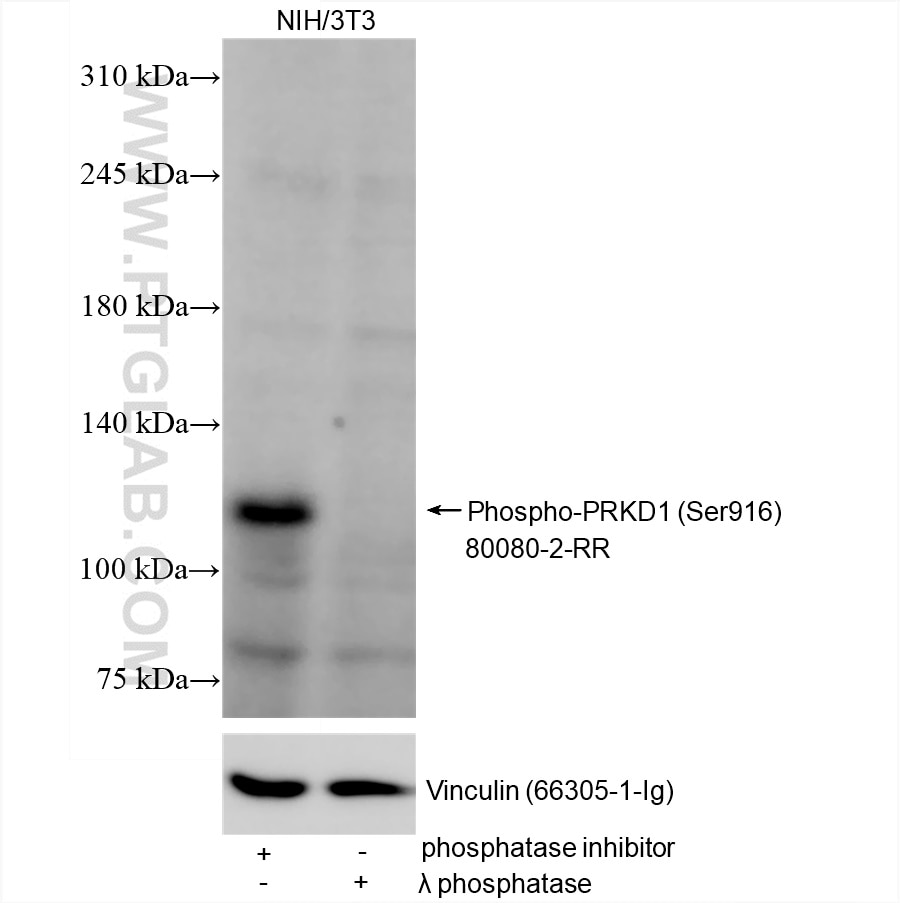
Geprüfte Anwendungen
Produktinformation
80080-2-PBS bindet in WB, Indirect ELISA Phospho-PRKD1 (Ser916) und zeigt Reaktivität mit human, Maus
| Getestete Reaktivität | human, Maus |
| Wirt / Isotyp | Kaninchen / IgG |
| Klonalität | Rekombinant |
| Typ | Antikörper |
| Immunogen | Peptid |
| Vollständiger Name | protein kinase D1 |
| Berechnetes Molekulargewicht | 102 kDa |
| Beobachtetes Molekulargewicht | 115 kDa |
| GenBank-Zugangsnummer | NM_001330069 |
| Gene symbol | PRKD1 |
| Gene ID (NCBI) | 5587 |
| Konjugation | Unkonjugiert |
| Form | Liquid |
| Reinigungsmethode | Protein A purfication |
| Lagerungspuffer | PBS only |
| Lagerungsbedingungen | Store at -80°C. 20ul Größen enthalten 0,1% BSA. |
Hintergrundinformationen
Protein kinase D1 (PRKD1), also named as PKD1 and PKCμ, is comprised of two cysteine-rich domains and a pleckstrin homology (PH) domain. PKD1 is involved in cellular processes including protein secretion, proliferation, cytoskeletal reorganization, Golgi function, immune function and apoptosis. It is widely expressed in thyroid, brain, heart, lung and other tissues. PKCs have been shown to regulate PKD1 activation. It has been reported that ser 916 is a PKD1 autophosphorylation site. PKD1 can be activated by growth factors, oxidative stress, thrombin, bioactive lipids, cross-linking of B- and T-cell receptors and some G-protein coupled receptors (GPCR). PKD1 is located mainly in the cytoplasm in unstimulated cells, while PKD1 migrates to the membrane in activated cells. (PMID: 17306383, 24806360, 30101477, 21696630)


