Phospho-TSC2 (Ser939) Rekombinanter Antikörper
Phospho-TSC2 (Ser939) Rekombinant Antikörper für FC (Intra)
Wirt / Isotyp
Kaninchen / IgG
Getestete Reaktivität
human
Anwendung
FC (Intra)
Konjugation
CoraLite® Plus 647 Fluorescent Dye
CloneNo.
2B18
Kat-Nr. : CL647-81654
Synonyme
Geprüfte Anwendungen
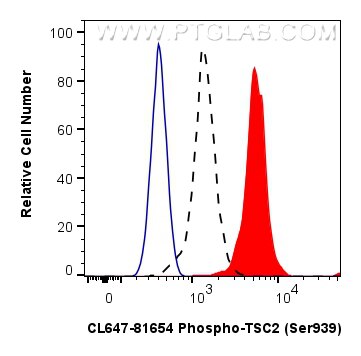
| Erfolgreiche Detektion in FC (Intra) | Mit Calyculin A behandelte HEK-293-Zellen |
Empfohlene Verdünnung
| Anwendung | Verdünnung |
|---|---|
| Durchflusszytometrie (FC) (INTRA) | FC (INTRA) : 0.25 ug per 10^6 cells in a 100 µl suspension |
| It is recommended that this reagent should be titrated in each testing system to obtain optimal results. | |
| Sample-dependent, check data in validation data gallery | |
Produktinformation
CL647-81654 bindet in FC (Intra) Phospho-TSC2 (Ser939) und zeigt Reaktivität mit human
| Getestete Reaktivität | human |
| Wirt / Isotyp | Kaninchen / IgG |
| Klonalität | Rekombinant |
| Typ | Antikörper |
| Immunogen | Peptid |
| Vollständiger Name | tuberous sclerosis 2 |
| Berechnetes Molekulargewicht | 1807 aa, 201 kDa |
| Beobachtetes Molekulargewicht | 200 kDa |
| GenBank-Zugangsnummer | BC150300 |
| Gene symbol | TSC2 |
| Gene ID (NCBI) | 7249 |
| Konjugation | CoraLite® Plus 647 Fluorescent Dye |
| Excitation/Emission maxima wavelengths | 654 nm / 674 nm |
| Form | Liquid |
| Reinigungsmethode | Protein-A-Reinigung |
| Lagerungspuffer | PBS with 50% glycerol, 0.05% Proclin300, 0.5% BSA |
| Lagerungsbedingungen | Bei -20°C lagern. Vor Licht schützen. Nach dem Versand ein Jahr stabil. Aliquotieren ist bei -20oC Lagerung nicht notwendig. 20ul Größen enthalten 0,1% BSA. |
Hintergrundinformationen
TSC2, also named Tuberin, plays an essential role in the cellular energy response pathway. TSC2 forms a physical and functional complex with TSC1 that can inhibit the nutrient-mediated or growth factor-stimulated phosphorylation of S6K1 and EIF4EBP1 by negatively regulating mTORC1 signaling. Tuberin is phosphorylated on Ser939 and Thr1462 in response to PI3K activation and the human TSC complex is a direct biochemical target of the PI3K/Akt pathway (PMID: 12150915).

