Prion protein PrP/CD230 Rekombinanter Antikörper
Prion protein PrP/CD230 Rekombinant Antikörper für WB, Indirect ELISA
Wirt / Isotyp
Kaninchen / IgG
Getestete Reaktivität
human
Anwendung
WB, Indirect ELISA
Konjugation
Unkonjugiert
CloneNo.
243104D11
Kat-Nr. : 85611-4-PBS
Synonyme
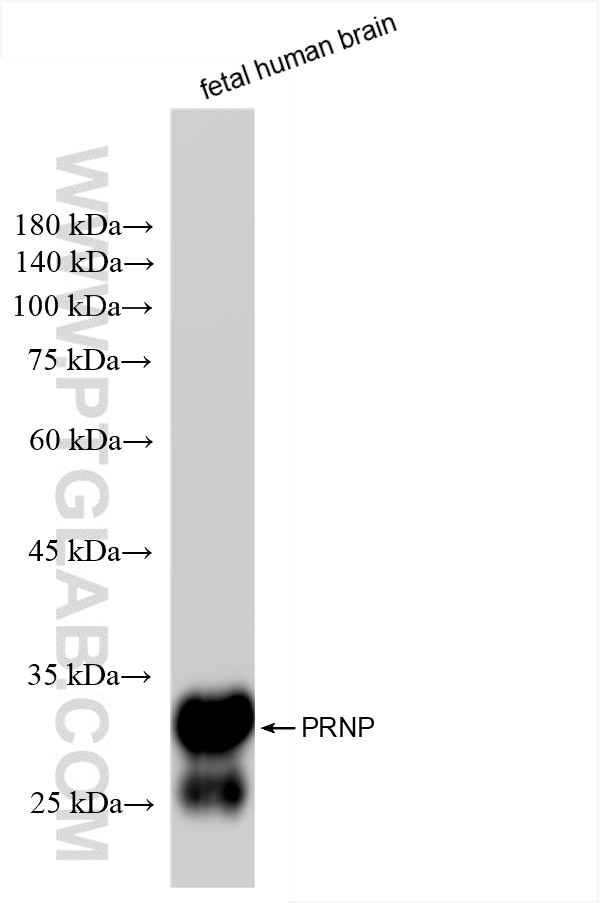
Geprüfte Anwendungen
Produktinformation
85611-4-PBS bindet in WB, Indirect ELISA Prion protein PrP/CD230 und zeigt Reaktivität mit human
| Getestete Reaktivität | human |
| Wirt / Isotyp | Kaninchen / IgG |
| Klonalität | Rekombinant |
| Typ | Antikörper |
| Immunogen | Prion protein PrP/CD230 fusion protein Eg3359 |
| Vollständiger Name | prion protein |
| Beobachtetes Molekulargewicht | 20-35 kDa |
| GenBank-Zugangsnummer | BC012844 |
| Gene symbol | PrP |
| Gene ID (NCBI) | 5621 |
| Konjugation | Unkonjugiert |
| Form | Liquid |
| Reinigungsmethode | Protein-A-Reinigung |
| Lagerungspuffer | PBS only |
| Lagerungsbedingungen | Store at -80°C. 20ul Größen enthalten 0,1% BSA. |
Hintergrundinformationen
Prion protein (PRNP) is a ubiquitous membrane glycoprotein whose abnormal self-replicating, misfolded form is widely believed to cause several central nervous system disorders, collectively known as Transmissible Spongiform Encephalopathies (TSE). Prion diseases are TSEs, attributed to conformational conversion of the cellular prion protein (PrPC) into an abnormal conformer that accumulates in the brain. The two isoforms, PrPC and PrPS, have the same primary amino acid sequence and only differ in conformation. While PrPC is composed of 42% α-helix and only 3% β-sheet, PrPSc is composed of 30% α-helix and 43% β-sheet. PrPC converts to its pathogenic isoform when the region corresponding to the residues 108-144 fold into β-sheets. PrPC is very soluble in detergents and easily digested by proteases while the PrPSc is insoluble in detergents and resistant to protease digestion. Prion diseases exist in infectious, sporadic, and genetic forms.


