Progranulin/PGRN Rekombinanter Antikörper
Progranulin/PGRN Rekombinant Antikörper für WB, ELISA
Wirt / Isotyp
Kaninchen / IgG
Getestete Reaktivität
human
Anwendung
WB, ELISA
Konjugation
Unkonjugiert
CloneNo.
250681G2
Kat-Nr. : 86118-2-RR
Synonyme
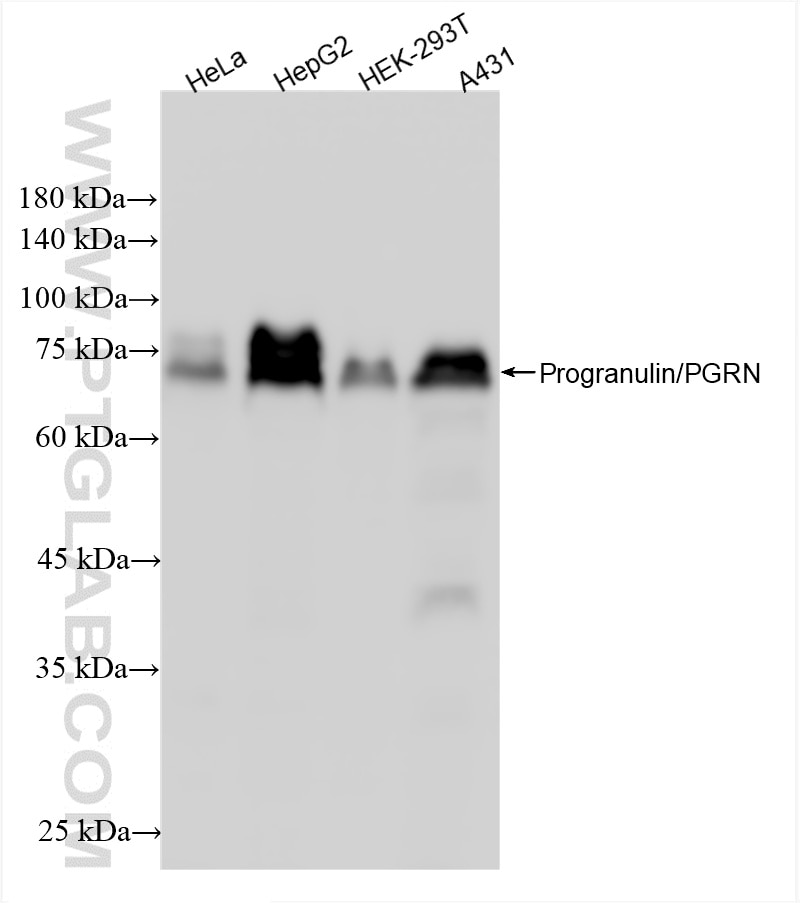
Geprüfte Anwendungen
| Erfolgreiche Detektion in WB | HeLa-Zellen, A431-Zellen, HEK-293T-Zellen, HepG2-Zellen |
Empfohlene Verdünnung
| Anwendung | Verdünnung |
|---|---|
| Western Blot (WB) | WB : 1:2000-1:10000 |
| It is recommended that this reagent should be titrated in each testing system to obtain optimal results. | |
| Sample-dependent, check data in validation data gallery | |
Produktinformation
86118-2-RR bindet in WB, ELISA Progranulin/PGRN und zeigt Reaktivität mit human
| Getestete Reaktivität | human |
| Wirt / Isotyp | Kaninchen / IgG |
| Klonalität | Rekombinant |
| Typ | Antikörper |
| Immunogen | Progranulin/PGRN fusion protein Eg2954 |
| Vollständiger Name | granulin |
| Berechnetes Molekulargewicht | 64 kDa |
| Beobachtetes Molekulargewicht | 74 kDa |
| GenBank-Zugangsnummer | NM_002087.3 |
| Gene symbol | Granulin |
| Gene ID (NCBI) | 2896 |
| Konjugation | Unkonjugiert |
| Form | Liquid |
| Reinigungsmethode | Protein-A-Reinigung |
| Lagerungspuffer | PBS with 0.02% sodium azide and 50% glycerol |
| Lagerungsbedingungen | Bei -20°C lagern. Nach dem Versand ein Jahr lang stabil Aliquotieren ist bei -20oC Lagerung nicht notwendig. 20ul Größen enthalten 0,1% BSA. |
Hintergrundinformationen
GRN, also known as PGRN or PCDGF, is a cysteine-rich protein of 68.5 kDa that is typically secreted into a highly glycosylated 88 kDa form. PGRN is a unique growth factor that plays an important role in cutaneous wound healing. It has an anti-inflammatory effect and promotes cell proliferation. When PCDGF is degraded to several 6-25 kDa fragments, called granulins (GRNs) by neutrophil proteases, a pro-inflammatory reaction occurs. PGRN is widely expressed, particularly in epithelial cells, immune cells, neurons, and chondrocytes. High levels of PGRN expression have been reported in human cancers, and its expression is closely correlated with the development and metastasis of several cancers. The recent discovery that mutations in the gene encoding for pro-granulin (GRN) cause frontotemporal lobar degeneration (FTLD), and other neurodegenerative diseases leading to dementia, has brought renewed interest in progranulin and its functions in the central nervous system.
Protokolle
| PRODUKTSPEZIFISCHE PROTOKOLLE | |
|---|---|
| WB protocol for Progranulin/PGRN antibody 86118-2-RR | Protokoll herunterladen |
| STANDARD-PROTOKOLLE | |
|---|---|
| Klicken Sie hier, um unsere Standardprotokolle anzuzeigen |

