RNGTT Rekombinanter Antikörper
RNGTT Rekombinant Antikörper für IF/ICC
Wirt / Isotyp
Kaninchen / IgG
Getestete Reaktivität
human
Anwendung
IF/ICC
Konjugation
CoraLite® Plus 488 Fluorescent Dye
CloneNo.
240927H2
Kat-Nr. : CL488-83974-4
Synonyme
Filter:
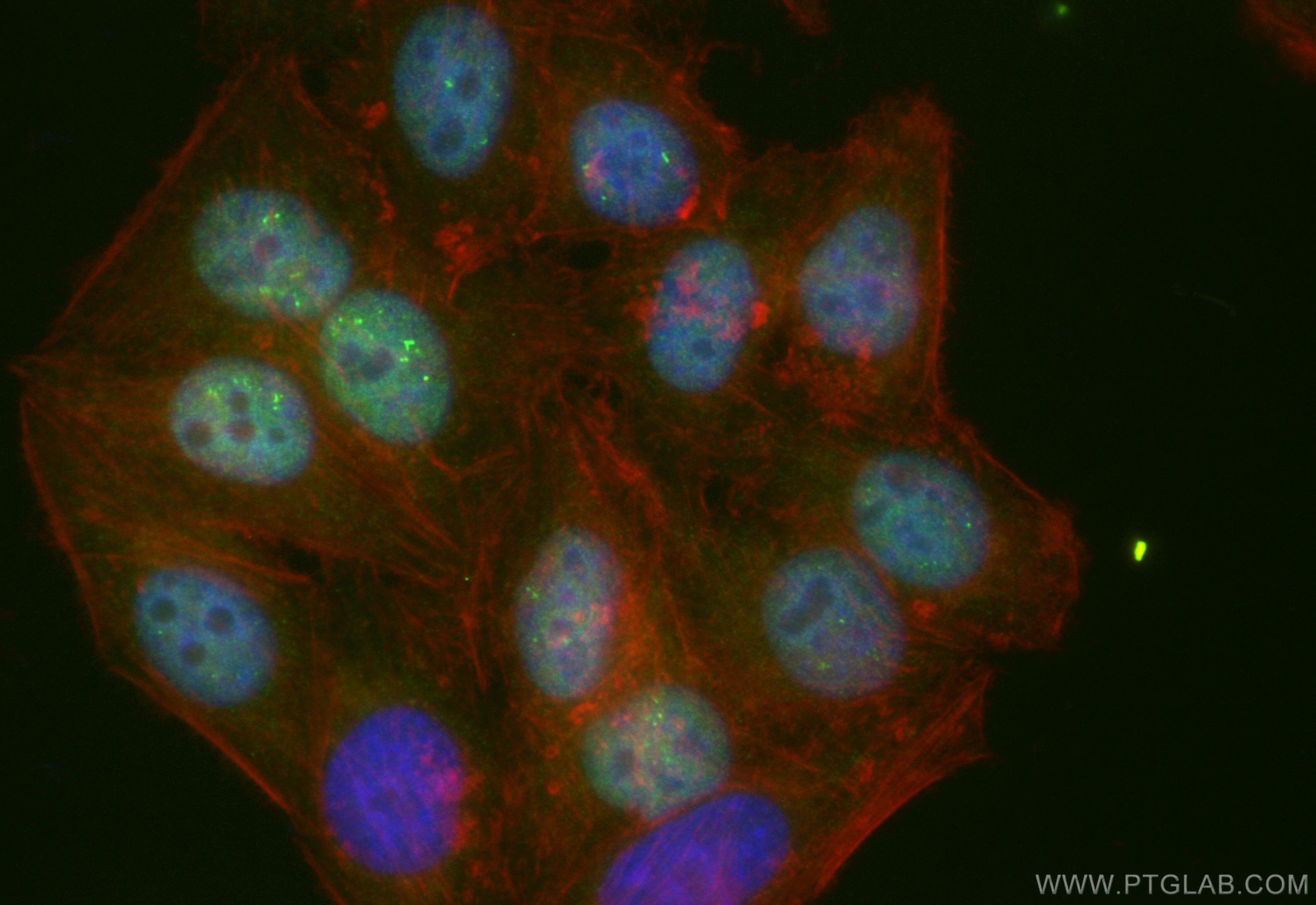
Geprüfte Anwendungen
| Erfolgreiche Detektion in IF/ICC | HepG2-Zellen |
Empfohlene Verdünnung
| Anwendung | Verdünnung |
|---|---|
| Immunfluoreszenz (IF)/ICC | IF/ICC : 1:50-1:500 |
| It is recommended that this reagent should be titrated in each testing system to obtain optimal results. | |
| Sample-dependent, check data in validation data gallery | |
Produktinformation
CL488-83974-4 bindet in IF/ICC RNGTT und zeigt Reaktivität mit human
| Getestete Reaktivität | human |
| Wirt / Isotyp | Kaninchen / IgG |
| Klonalität | Rekombinant |
| Typ | Antikörper |
| Immunogen | RNGTT fusion protein Ag3105 |
| Vollständiger Name | RNA guanylyltransferase and 5'-phosphatase |
| Berechnetes Molekulargewicht | 597 aa, 69 kDa |
| GenBank-Zugangsnummer | BC019954 |
| Gene symbol | RNGTT |
| Gene ID (NCBI) | 8732 |
| Konjugation | CoraLite® Plus 488 Fluorescent Dye |
| Excitation/Emission maxima wavelengths | 493 nm / 522 nm |
| Form | Liquid |
| Reinigungsmethode | Protein-A-Reinigung |
| Lagerungspuffer | PBS with 50% glycerol, 0.05% Proclin300, 0.5% BSA |
| Lagerungsbedingungen | Bei -20°C lagern. Vor Licht schützen. Nach dem Versand ein Jahr stabil. Aliquotieren ist bei -20oC Lagerung nicht notwendig. 20ul Größen enthalten 0,1% BSA. |
Hintergrundinformationen
RNGTT(mRNA-capping enzyme) is also named as HCAP1, HCE, CAP1A. In the N-terminal section it belongs to the non-receptor class of the protein-tyrosine phosphatase family and in the C-terminal section it belongs to the eukaryotic GTase family. It is a bifunctional 597-amino acid protein with RNA triphosphatase and RNA guanylyltransferase activities(PMID:9545288). It has 4 isoforms produced by alternative splicing.
Protokolle
| PRODUKTSPEZIFISCHE PROTOKOLLE | |
|---|---|
| IF protocol for CL Plus 488 RNGTT antibody CL488-83974-4 | Protokoll herunterladen |
| STANDARD-PROTOKOLLE | |
|---|---|
| Klicken Sie hier, um unsere Standardprotokolle anzuzeigen |

