RPRD2 Polyklonaler Antikörper
RPRD2 Polyklonal Antikörper für WB, Indirect ELISA
Wirt / Isotyp
Kaninchen / IgG
Getestete Reaktivität
human
Anwendung
WB, Indirect ELISA
Konjugation
Unkonjugiert
Kat-Nr. : 33037-1-PBS
Synonyme
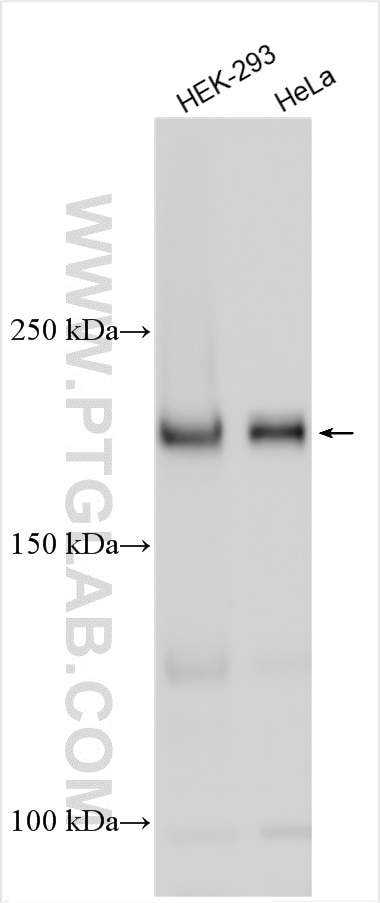
Geprüfte Anwendungen
Produktinformation
33037-1-PBS bindet in WB, Indirect ELISA RPRD2 und zeigt Reaktivität mit human
| Getestete Reaktivität | human |
| Wirt / Isotyp | Kaninchen / IgG |
| Klonalität | Polyklonal |
| Typ | Antikörper |
| Immunogen | RPRD2 fusion protein Ag35410 |
| Vollständiger Name | regulation of nuclear pre-mRNA domain containing 2 |
| Berechnetes Molekulargewicht | 155 kDa |
| Beobachtetes Molekulargewicht | 220 kDa |
| GenBank-Zugangsnummer | BC045623 |
| Gene symbol | RPRD2 |
| Gene ID (NCBI) | 23248 |
| Konjugation | Unkonjugiert |
| Form | Liquid |
| Reinigungsmethode | Antigen-Affinitätsreinigung |
| Lagerungspuffer | PBS only |
| Lagerungsbedingungen | Store at -80°C. 20ul Größen enthalten 0,1% BSA. |
Hintergrundinformationen
RPRD2 (or RNA-associated early-stage antiviral factor) has been shown to be upregulated upon T cell activation, is highly expressed in myeloid cells, binds viral reverse transcripts, and potently restricts HIV-1 infection. RPRD2 is also bound by HIV-1 Vpr and targeted for degradation by the proteasome upon reverse transcription, suggesting RPRD2 impedes reverse transcription and Vpr targeting overcomes this block. RPRD2 is mainly localized to the nucleus and binds RNA, DNA, and DNA:RNA hybrids. RPRD2 has been shown to negatively regulate genome-wide transcription and interact with the HUSH and PAF1 complexes which repress HIV transcription and are implicated in maintenance of HIV latency (PMID: 37882563).


