RSPH1 Polyklonaler Antikörper
RSPH1 Polyklonal Antikörper für WB, ELISA
Wirt / Isotyp
Kaninchen / IgG
Getestete Reaktivität
human
Anwendung
WB, ELISA
Konjugation
Unkonjugiert
Kat-Nr. : 32033-1-AP
Synonyme
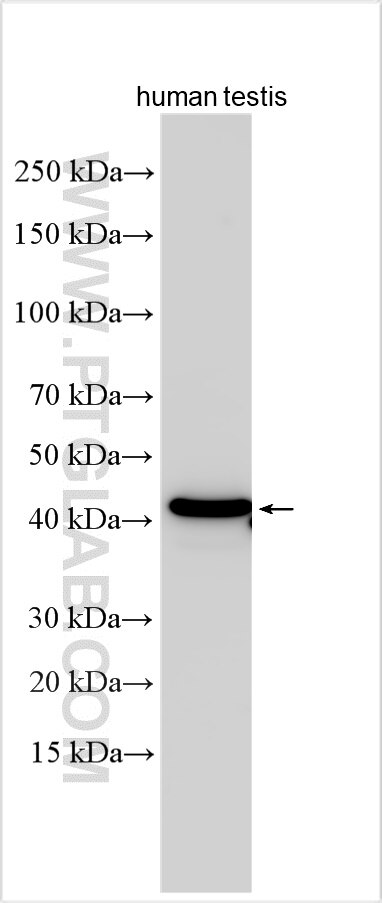
Geprüfte Anwendungen
| Erfolgreiche Detektion in WB | humanes Hodengewebe |
Empfohlene Verdünnung
| Anwendung | Verdünnung |
|---|---|
| Western Blot (WB) | WB : 1:1000-1:5000 |
| It is recommended that this reagent should be titrated in each testing system to obtain optimal results. | |
| Sample-dependent, check data in validation data gallery | |
Produktinformation
32033-1-AP bindet in WB, ELISA RSPH1 und zeigt Reaktivität mit human
| Getestete Reaktivität | human |
| Wirt / Isotyp | Kaninchen / IgG |
| Klonalität | Polyklonal |
| Typ | Antikörper |
| Immunogen | RSPH1 fusion protein Ag36560 |
| Vollständiger Name | radial spoke head 1 homolog (Chlamydomonas) |
| Berechnetes Molekulargewicht | 309 aa, 35 kDa |
| Beobachtetes Molekulargewicht | 41 kDa |
| GenBank-Zugangsnummer | BC101519 |
| Gene symbol | RSPH1 |
| Gene ID (NCBI) | 89765 |
| Konjugation | Unkonjugiert |
| Form | Liquid |
| Reinigungsmethode | Antigen-Affinitätsreinigung |
| Lagerungspuffer | PBS with 0.02% sodium azide and 50% glycerol |
| Lagerungsbedingungen | Bei -20°C lagern. Nach dem Versand ein Jahr lang stabil Aliquotieren ist bei -20oC Lagerung nicht notwendig. 20ul Größen enthalten 0,1% BSA. |
Hintergrundinformationen
RSPH1 (Radial Spoke Head Component 1) encodes a male mid-meiotic chromosome-associated acidic protein involved in the structure and function of cilia and flagella. Pathogenic variants of RSPH1 lead to impaired spermatocyte motility and aberrant flagellar composition, which further contribute to male infertility. In addition to this, mutations in the RSPH1 gene lead to primary ciliary dyskinesia-24 (PCD-24), an autosomal recessive disorder that affects the motor function of cilia and flagella.
Protokolle
| PRODUKTSPEZIFISCHE PROTOKOLLE | |
|---|---|
| WB protocol for RSPH1 antibody 32033-1-AP | Protokoll herunterladen |
| STANDARD-PROTOKOLLE | |
|---|---|
| Klicken Sie hier, um unsere Standardprotokolle anzuzeigen |

