SLAM/CD150 Polyklonaler Antikörper
SLAM/CD150 Polyklonal Antikörper für WB, ELISA
Wirt / Isotyp
Kaninchen / IgG
Getestete Reaktivität
Maus
Anwendung
WB, ELISA
Konjugation
Unkonjugiert
Kat-Nr. : 32660-1-AP
Synonyme
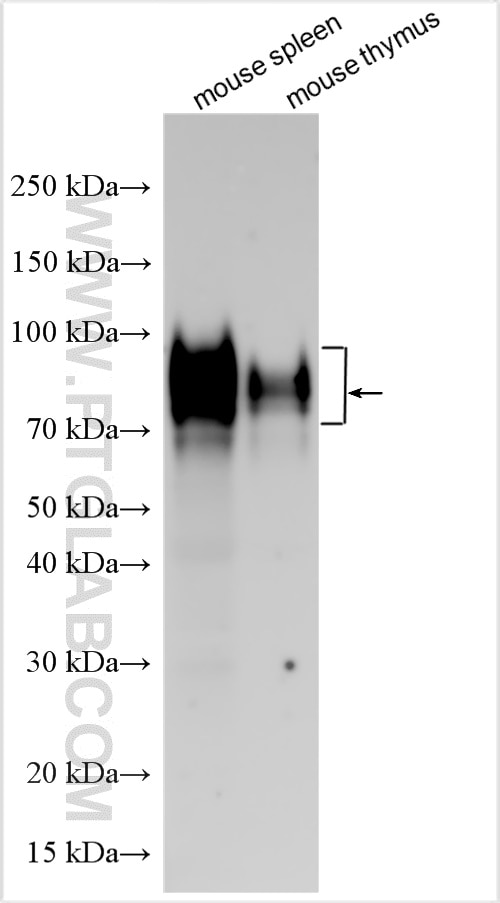
Geprüfte Anwendungen
| Erfolgreiche Detektion in WB | Mausmilzgewebe, Maus-Thymusgewebe |
Empfohlene Verdünnung
| Anwendung | Verdünnung |
|---|---|
| Western Blot (WB) | WB : 1:500-1:1000 |
| It is recommended that this reagent should be titrated in each testing system to obtain optimal results. | |
| Sample-dependent, check data in validation data gallery | |
Produktinformation
32660-1-AP bindet in WB, ELISA SLAM/CD150 und zeigt Reaktivität mit Maus
| Getestete Reaktivität | Maus |
| Wirt / Isotyp | Kaninchen / IgG |
| Klonalität | Polyklonal |
| Typ | Antikörper |
| Immunogen | SLAM/CD150 fusion protein Eg2787 |
| Vollständiger Name | signaling lymphocytic activation molecule family member 1 |
| Berechnetes Molekulargewicht | 38 kDa |
| Beobachtetes Molekulargewicht | 70-90 kDa |
| GenBank-Zugangsnummer | NM_013730.4 |
| Gene symbol | Slamf1 |
| Gene ID (NCBI) | 27218 |
| Konjugation | Unkonjugiert |
| Form | Liquid |
| Reinigungsmethode | Antigen-Affinitätsreinigung |
| Lagerungspuffer | PBS with 0.02% sodium azide and 50% glycerol |
| Lagerungsbedingungen | Bei -20°C lagern. Nach dem Versand ein Jahr lang stabil Aliquotieren ist bei -20oC Lagerung nicht notwendig. 20ul Größen enthalten 0,1% BSA. |
Hintergrundinformationen
Signaling lymphocytic activation molecule (SLAM, also known as SLAMF1 or CD150) is a 70-95 kDa transmembrane glycoprotein that belongs to the immunoglobulin gene superfamily. SLAM is constitutively expressed on peripheral blood memory T-cells, T-cell clones, immature thymocytes and a proportion of B-cells, and is rapidly induced on naive T-cells after activation. SLAM is involved in T cell stimulation and cytokine production, and may play an important role in the regulation of immune responses to pathogens.
Protokolle
| PRODUKTSPEZIFISCHE PROTOKOLLE | |
|---|---|
| WB protocol for SLAM/CD150 antibody 32660-1-AP | Protokoll herunterladen |
| STANDARD-PROTOKOLLE | |
|---|---|
| Klicken Sie hier, um unsere Standardprotokolle anzuzeigen |

