SLC12A3/NCCT Polyklonaler Antikörper
SLC12A3/NCCT Polyklonal Antikörper für WB, ELISA
Wirt / Isotyp
Kaninchen / IgG
Getestete Reaktivität
human, Maus
Anwendung
WB, ELISA
Konjugation
Unkonjugiert
Kat-Nr. : 55442-1-AP
Synonyme
Filter:
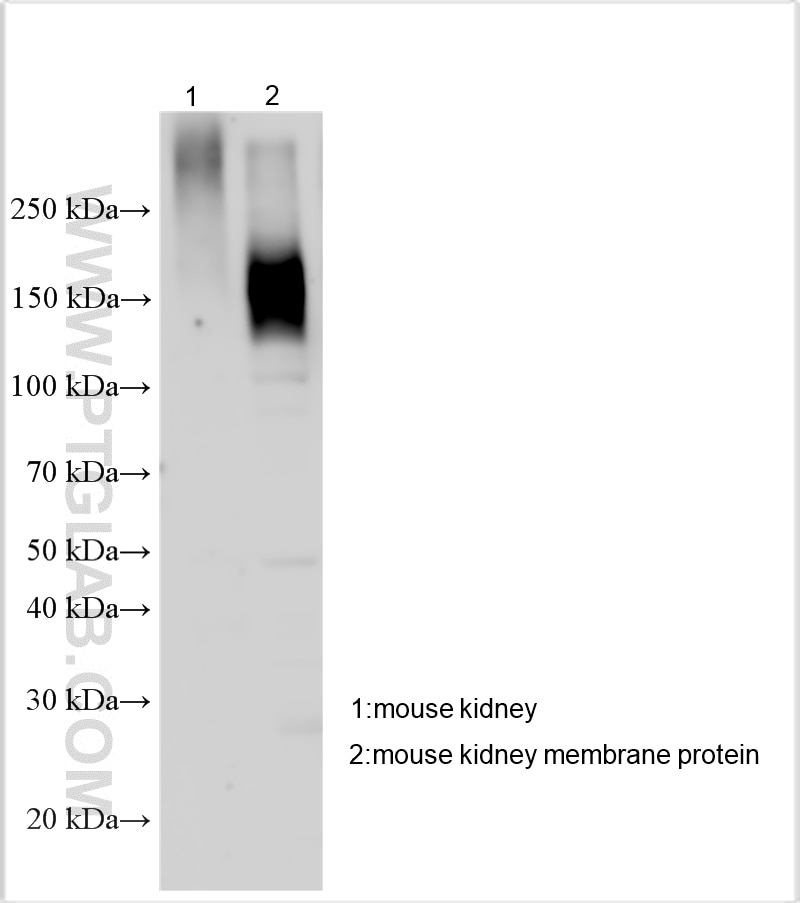
Geprüfte Anwendungen
| Erfolgreiche Detektion in WB | bei 37°C inkubiertes Mausnierengewebe |
Empfohlene Verdünnung
| Anwendung | Verdünnung |
|---|---|
| Western Blot (WB) | WB : 1:1000-1:4000 |
| It is recommended that this reagent should be titrated in each testing system to obtain optimal results. | |
| Sample-dependent, check data in validation data gallery | |
Produktinformation
55442-1-AP bindet in WB, ELISA SLC12A3/NCCT und zeigt Reaktivität mit human, Maus
| Getestete Reaktivität | human, Maus |
| Wirt / Isotyp | Kaninchen / IgG |
| Klonalität | Polyklonal |
| Typ | Antikörper |
| Immunogen | Peptid |
| Vollständiger Name | solute carrier family 12 (sodium/chloride transporters), member 3 |
| Berechnetes Molekulargewicht | 114 kDa |
| Beobachtetes Molekulargewicht | 150 kDa |
| GenBank-Zugangsnummer | NM_000339 |
| Gene symbol | SLC12A3 |
| Gene ID (NCBI) | 6559 |
| Konjugation | Unkonjugiert |
| Form | Liquid |
| Reinigungsmethode | Antigen-Affinitätsreinigung |
| Lagerungspuffer | PBS with 0.02% sodium azide and 50% glycerol |
| Lagerungsbedingungen | Bei -20°C lagern. Nach dem Versand ein Jahr lang stabil Aliquotieren ist bei -20oC Lagerung nicht notwendig. 20ul Größen enthalten 0,1% BSA. |
Hintergrundinformationen
SLC12A3 also known as NCCT, NCC, is a sodium-chloride cotransporter (NCC), which mainly functions in the distal convoluted tubules of the kidney and is responsible for the reabsorption of sodium ions and chloride ions (PMID: 35591852). This cotransporter is the target of thiazide diuretics used in the treatment of hypertension. Mutations in SLC12A3 cause Gitelman syndrome(PMID: 8528245, 33462018).
Protokolle
| PRODUKTSPEZIFISCHE PROTOKOLLE | |
|---|---|
| WB protocol for SLC12A3/NCCT antibody 55442-1-AP | Protokoll herunterladen |
| STANDARD-PROTOKOLLE | |
|---|---|
| Klicken Sie hier, um unsere Standardprotokolle anzuzeigen |

