- Featured Product
- KD/KO Validated
SQLE Polyklonaler Antikörper
SQLE Polyklonal Antikörper für IF/ICC
Wirt / Isotyp
Kaninchen / IgG
Getestete Reaktivität
human, Maus, Ratte
Anwendung
IF/ICC
Konjugation
CoraLite® Plus 488 Fluorescent Dye
Kat-Nr. : CL488-12544
Synonyme
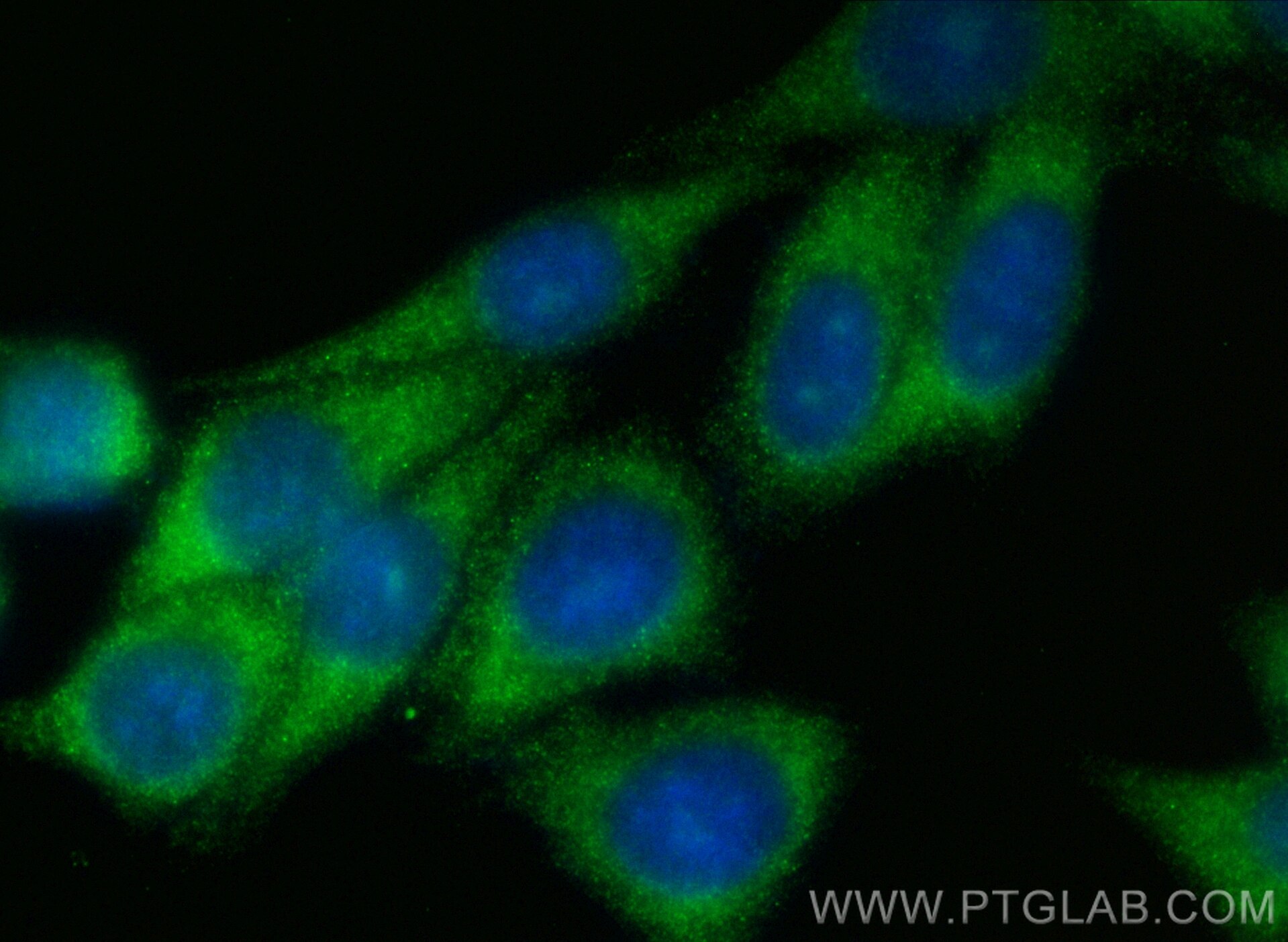
Geprüfte Anwendungen
| Erfolgreiche Detektion in IF/ICC | HepG2-Zellen |
Empfohlene Verdünnung
| Anwendung | Verdünnung |
|---|---|
| Immunfluoreszenz (IF)/ICC | IF/ICC : 1:50-1:500 |
| It is recommended that this reagent should be titrated in each testing system to obtain optimal results. | |
| Sample-dependent, check data in validation data gallery | |
Produktinformation
CL488-12544 bindet in IF/ICC SQLE und zeigt Reaktivität mit human, Maus, Ratten
| Getestete Reaktivität | human, Maus, Ratte |
| Wirt / Isotyp | Kaninchen / IgG |
| Klonalität | Polyklonal |
| Typ | Antikörper |
| Immunogen | SQLE fusion protein Ag3266 |
| Vollständiger Name | squalene epoxidase |
| Berechnetes Molekulargewicht | 574 aa, 64 kDa |
| Beobachtetes Molekulargewicht | 50-64 kDa |
| GenBank-Zugangsnummer | BC017033 |
| Gene symbol | SQLE |
| Gene ID (NCBI) | 6713 |
| Konjugation | CoraLite® Plus 488 Fluorescent Dye |
| Excitation/Emission maxima wavelengths | 493 nm / 522 nm |
| Form | Liquid |
| Reinigungsmethode | Antigen-Affinitätsreinigung |
| Lagerungspuffer | PBS with 50% glycerol, 0.05% Proclin300, 0.5% BSA |
| Lagerungsbedingungen | Bei -20°C lagern. Vor Licht schützen. Nach dem Versand ein Jahr stabil. Aliquotieren ist bei -20oC Lagerung nicht notwendig. 20ul Größen enthalten 0,1% BSA. |
Hintergrundinformationen
SQLE, also named as ERG1, SE and SM, belongs to the squalene monooxygenase family. It catalyzes the first oxygenation step in cholesterol synthesis, acting on squalene before cyclization into the basic steroid structure. SQLE may serve as a flux-controlling enzyme beyond 3-hydroxy-3-methylglutaryl-coenzyme A reductase (HMGR, considered as rate limiting). It is also posttranslationally regulated by cholesterol-dependent proteasomal degradation. SQLE is subject to feedback regulation via cholesterol-induced degradation, which depends on its lipid-sensing N terminal regulatory domain. Truncation of SQLE occurs during its endoplasmic reticulum-associated degradation and requires the proteasome, which partially degrades the SQLE N-terminus and eliminates cholesterol-sensing elements within this region. The MW of SQLE is about 50-64 kDa. (PMID:21356516, PMID: 28972164)
Protokolle
| PRODUKTSPEZIFISCHE PROTOKOLLE | |
|---|---|
| IF protocol for CL Plus 488 SQLE antibody CL488-12544 | Protokoll herunterladen |
| STANDARD-PROTOKOLLE | |
|---|---|
| Klicken Sie hier, um unsere Standardprotokolle anzuzeigen |

