SRP68 Polyklonaler Antikörper
SRP68 Polyklonal Antikörper für IF/ICC
Wirt / Isotyp
Kaninchen / IgG
Getestete Reaktivität
human, Maus, Ratte
Anwendung
IF/ICC
Konjugation
CoraLite® Plus 488 Fluorescent Dye
Kat-Nr. : CL488-11585
Synonyme
Filter:
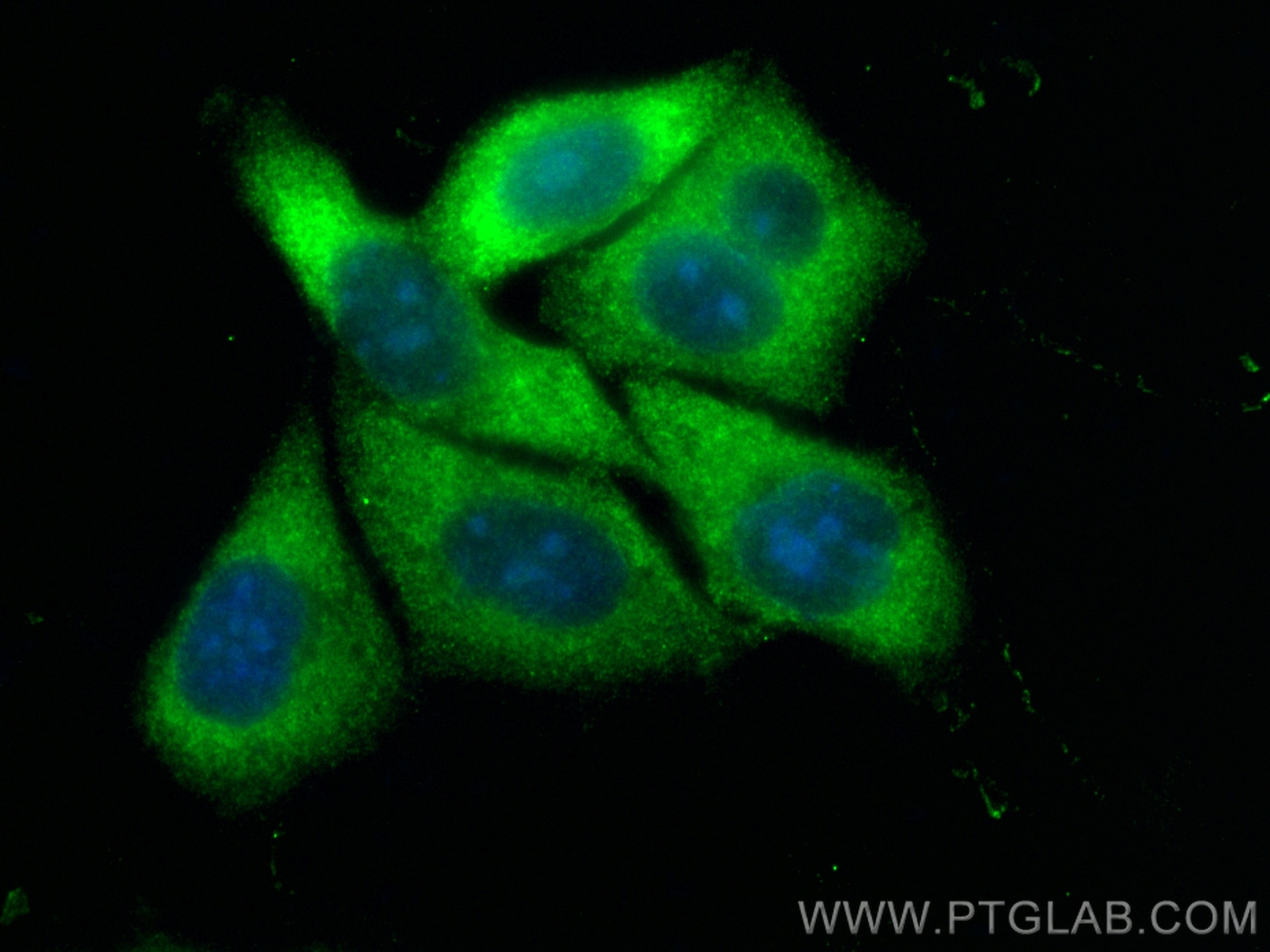
Geprüfte Anwendungen
| Erfolgreiche Detektion in IF/ICC | HepG2-Zellen |
Empfohlene Verdünnung
| Anwendung | Verdünnung |
|---|---|
| Immunfluoreszenz (IF)/ICC | IF/ICC : 1:50-1:500 |
| It is recommended that this reagent should be titrated in each testing system to obtain optimal results. | |
| Sample-dependent, check data in validation data gallery | |
Produktinformation
CL488-11585 bindet in IF/ICC SRP68 und zeigt Reaktivität mit human, Maus, Ratten
| Getestete Reaktivität | human, Maus, Ratte |
| Wirt / Isotyp | Kaninchen / IgG |
| Klonalität | Polyklonal |
| Typ | Antikörper |
| Immunogen | SRP68 fusion protein Ag2177 |
| Vollständiger Name | signal recognition particle 68kDa |
| Berechnetes Molekulargewicht | 68 kDa |
| Beobachtetes Molekulargewicht | 68 kDa |
| GenBank-Zugangsnummer | BC020238 |
| Gene symbol | SRP68 |
| Gene ID (NCBI) | 6730 |
| Konjugation | CoraLite® Plus 488 Fluorescent Dye |
| Excitation/Emission maxima wavelengths | 493 nm / 522 nm |
| Form | Liquid |
| Reinigungsmethode | Antigen-Affinitätsreinigung |
| Lagerungspuffer | PBS with 50% glycerol, 0.05% Proclin300, 0.5% BSA |
| Lagerungsbedingungen | Bei -20°C lagern. Vor Licht schützen. Nach dem Versand ein Jahr stabil. Aliquotieren ist bei -20oC Lagerung nicht notwendig. 20ul Größen enthalten 0,1% BSA. |
Hintergrundinformationen
The signal recognition particle (SRP) is a ribonucleoprotein complex that mediates the targeting of secretory proteins to the rough endoplasmic reticulum (ER) membrane. This ribonucleoprotein complex might interact directly with the docking protein in the ER membrane and possibly participate in the elongation arrest function. SRP68 is one component of the ribonucleprotein complex, and forms a heterodimer with SRP72.
Protokolle
| PRODUKTSPEZIFISCHE PROTOKOLLE | |
|---|---|
| IF protocol for CL Plus 488 SRP68 antibody CL488-11585 | Protokoll herunterladen |
| STANDARD-PROTOKOLLE | |
|---|---|
| Klicken Sie hier, um unsere Standardprotokolle anzuzeigen |

