STMN3 Monoklonaler Antikörper
STMN3 Monoklonal Antikörper für WB, Indirect ELISA
Wirt / Isotyp
Maus / IgG2b
Getestete Reaktivität
human
Anwendung
WB, Indirect ELISA
Konjugation
Unkonjugiert
CloneNo.
1F12B1
Kat-Nr. : 66152-1-PBS
Synonyme
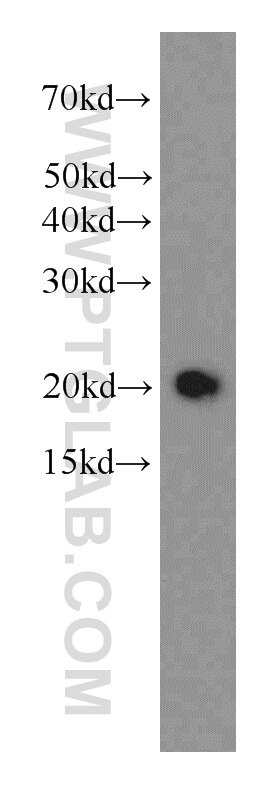
Geprüfte Anwendungen
Produktinformation
66152-1-PBS bindet in WB, Indirect ELISA STMN3 und zeigt Reaktivität mit human
| Getestete Reaktivität | human |
| Wirt / Isotyp | Maus / IgG2b |
| Klonalität | Monoklonal |
| Typ | Antikörper |
| Immunogen | STMN3 fusion protein Ag18844 |
| Vollständiger Name | stathmin-like 3 |
| Berechnetes Molekulargewicht | 21 kDa |
| Beobachtetes Molekulargewicht | 21 kDa |
| GenBank-Zugangsnummer | BC009381 |
| Gene symbol | STMN3 |
| Gene ID (NCBI) | 50861 |
| Konjugation | Unkonjugiert |
| Form | Liquid |
| Reinigungsmethode | Protein-A-Reinigung |
| Lagerungspuffer | PBS only |
| Lagerungsbedingungen | Store at -80°C. 20ul Größen enthalten 0,1% BSA. |
Hintergrundinformationen
Stathmin family phosphoproteins participate in the control of microtubule dynamics and have been proposed to be involved in the control of neuronal differentiation. Neuron specific Stathmin-3 (STMN3) is a novel STAT3 (signal transducer and activator of transcription 3) interacting protein. STAT3 is a key contributor to cancer cell migration and invasion. STMN3 exhibits microtubule-destabilizing activity, which is antagonized by STAT3. SCG10 is a widely studied and recognized neuronal differentiation marker, STMN3 is a SCG10-like protein (SCLIP) and is present from the earliest stages of hippocampal neuron differentiation in culture at vesicle-like structures following dynamic microtubules. RNAi mediated inhibition of this gene resulted in increased axonal branching.


