TMEM26 Polyklonaler Antikörper
TMEM26 Polyklonal Antikörper für WB, Indirect ELISA
Wirt / Isotyp
Kaninchen / IgG
Getestete Reaktivität
human
Anwendung
WB, Indirect ELISA
Konjugation
Unkonjugiert
Kat-Nr. : 27267-1-PBS
Synonyme
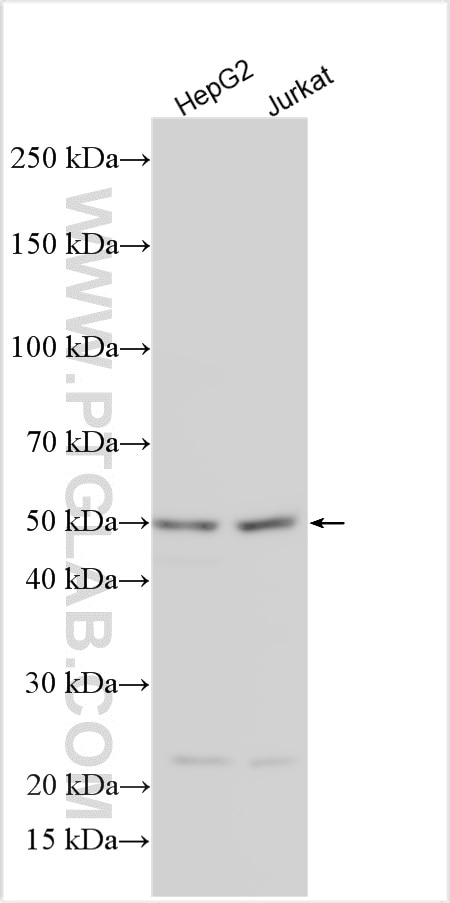
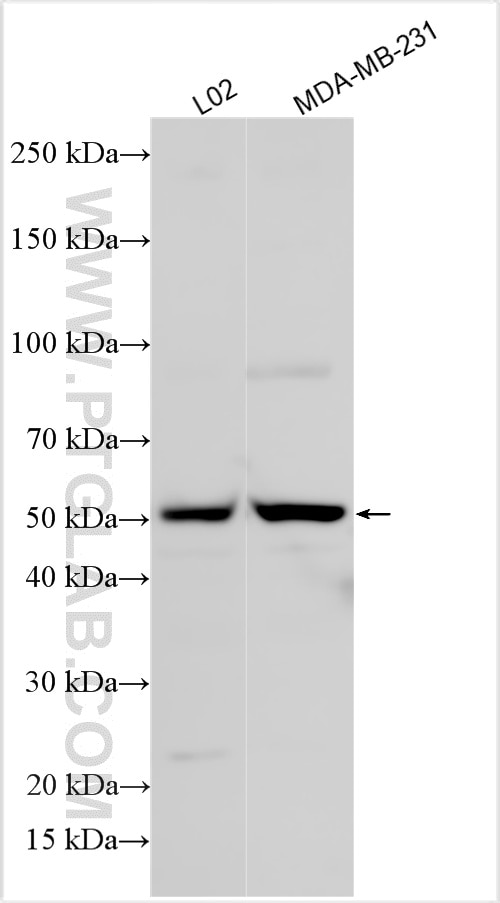
Geprüfte Anwendungen
Produktinformation
27267-1-PBS bindet in WB, Indirect ELISA TMEM26 und zeigt Reaktivität mit human
| Getestete Reaktivität | human |
| Wirt / Isotyp | Kaninchen / IgG |
| Klonalität | Polyklonal |
| Typ | Antikörper |
| Immunogen | TMEM26 fusion protein Ag24409 |
| Vollständiger Name | transmembrane protein 26 |
| Berechnetes Molekulargewicht | 368 aa, 42 kDa |
| Beobachtetes Molekulargewicht | 50 kDa |
| GenBank-Zugangsnummer | BC042872 |
| Gene symbol | TMEM26 |
| Gene ID (NCBI) | 219623 |
| Konjugation | Unkonjugiert |
| Form | Liquid |
| Reinigungsmethode | Antigen-Affinitätsreinigung |
| Lagerungspuffer | PBS only |
| Lagerungsbedingungen | Store at -80°C. 20ul Größen enthalten 0,1% BSA. |
Hintergrundinformationen
The Transmembrane protein 26 (TMEM26) gene encodes a protein containing multiple transmembrane fragments. Immunostaining indicated elevated TMEM26 expression in ESCC tumors. Various ESCC cell lines showed a high TMEM26 expression, where its plasma membrane localization was confirmed. The RNAi depletion of TMEM26 in TMEM26-high ESCC cells suppressed EMT-related alterations, including invasion, migration, and marker gene expression. Conversely, TMEM26 overexpression in TMEM26-low ESCC cells promoted these EMT-related alterations. Interestingly, TMEM26 depletion or overexpression did not affect cell growth, indicating its specific involvement in the EMT process. The animal study demonstrated the contributive role of TMEM26 in metastatic ESCC. Mechanistically, TMEM26 promoted NF-κB signaling to accelerate EMT in ESCC cells. The plasma membrane presentation and TJ protein assembly were impaired by TMEM26, which was likely to be another mechanism for EMT regulation by TMEM26 in ESCC. Therefore, TMEM26 disrupted TJ formation and promoted NF-κB signaling during the EMT activation in ESCC (PMID: 37611445). TMEM26 shows features for chain, glycosylation, modified residue (large scale data).


