TNFSF18 Rekombinanter Antikörper
TNFSF18 Rekombinant Antikörper für FC
Wirt / Isotyp
Kaninchen / IgG
Getestete Reaktivität
human
Anwendung
FC
Konjugation
Unkonjugiert
CloneNo.
250008B9
Kat-Nr. : 98403-3-RR
Synonyme
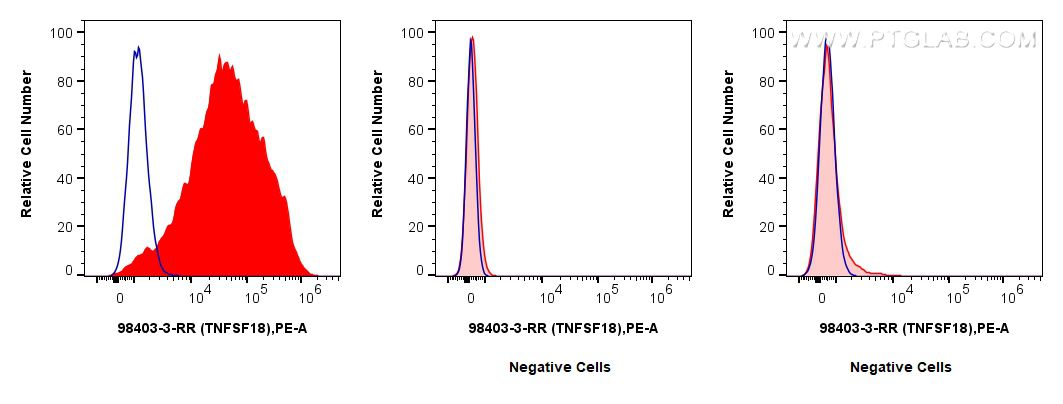
Geprüfte Anwendungen
| Erfolgreiche Detektion in FC | HUVEC-Zellen |
Empfohlene Verdünnung
| Anwendung | Verdünnung |
|---|---|
| This reagent has been tested for flow cytometric analysis. It is recommended that this reagent should be titrated in each testing system to obtain optimal results. | |
| Sample-dependent, check data in validation data gallery | |
Produktinformation
98403-3-RR bindet in FC TNFSF18 und zeigt Reaktivität mit human
| Getestete Reaktivität | human |
| Wirt / Isotyp | Kaninchen / IgG |
| Klonalität | Rekombinant |
| Typ | Antikörper |
| Immunogen | TNFSF18 fusion protein Eg32094 |
| Vollständiger Name | tumor necrosis factor (ligand) superfamily, member 18 |
| Berechnetes Molekulargewicht | 177 aa, 20 kDa |
| GenBank-Zugangsnummer | BC069319 |
| Gene symbol | TNFSF18 |
| Gene ID (NCBI) | 8995 |
| Konjugation | Unkonjugiert |
| Form | Liquid |
| Reinigungsmethode | Protein-A-Reinigung |
| Lagerungspuffer | PBS with 0.09% sodium azide |
| Lagerungsbedingungen | Store at 2 - 8°C. Stable for one year after shipment. |
Hintergrundinformationen
TNFSF18 (Tumor Necrosis Factor Superfamily Member 18), also known as GITRL (Glucocorticoid-Induced TNF Receptor Ligand) or AITRL (Activation-Induced T Cell Receptor Ligand), is a cytokine belonging to the tumor necrosis factor (TNF) ligand family. TNFSF18 is broadly expressed in various tissues, including the gallbladder, brain, and other tissues. TNFSF18 is expressed on the surface of antigen-presenting cells (APCs) such as dendritic cells, macrophages, and B cells. It is also found in endothelial cells, which play a role in the interaction between T lymphocytes and endothelial cells.
Protokolle
| PRODUKTSPEZIFISCHE PROTOKOLLE | |
|---|---|
| FC protocol for TNFSF18 antibody 98403-3-RR | Download protocol |
| STANDARD-PROTOKOLLE | |
|---|---|
| Klicken Sie hier, um unsere Standardprotokolle anzuzeigen |

