TXLNB Polyklonaler Antikörper
TXLNB Polyklonal Antikörper für WB, Indirect ELISA
Wirt / Isotyp
Kaninchen / IgG
Getestete Reaktivität
human, Maus
Anwendung
WB, Indirect ELISA
Konjugation
Unkonjugiert
Kat-Nr. : 22090-1-PBS
Synonyme
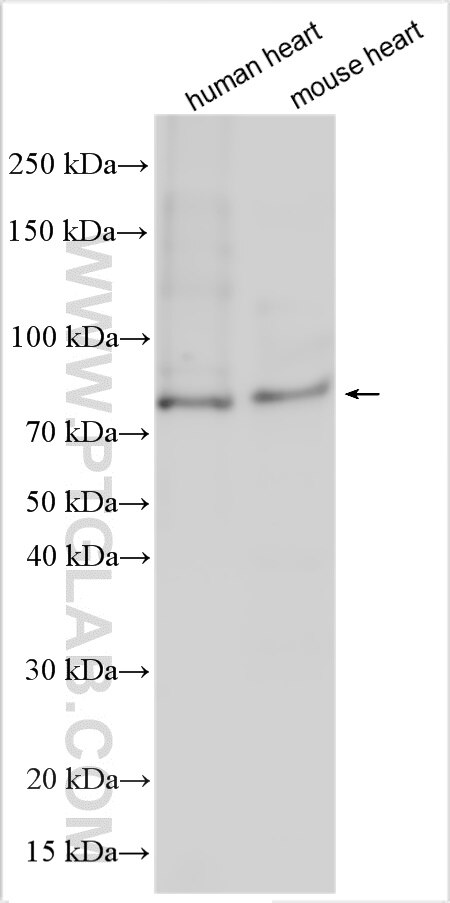
Geprüfte Anwendungen
Produktinformation
22090-1-PBS bindet in WB, Indirect ELISA TXLNB und zeigt Reaktivität mit human, Maus
| Getestete Reaktivität | human, Maus |
| Wirt / Isotyp | Kaninchen / IgG |
| Klonalität | Polyklonal |
| Typ | Antikörper |
| Immunogen | TXLNB fusion protein Ag17295 |
| Vollständiger Name | taxilin beta |
| Berechnetes Molekulargewicht | 684 aa, 77 kDa |
| Beobachtetes Molekulargewicht | 75 kDa |
| GenBank-Zugangsnummer | BC115383 |
| Gene symbol | TXLNB |
| Gene ID (NCBI) | 167838 |
| Konjugation | Unkonjugiert |
| Form | Liquid |
| Reinigungsmethode | Antigen-Affinitätsreinigung |
| Lagerungspuffer | PBS only |
| Lagerungsbedingungen | Store at -80°C. 20ul Größen enthalten 0,1% BSA. |
Hintergrundinformationen
TXLNB (Taxilin beta, gliding protein beta) is a protein enriched predominantly in cardiomyocytes and belongs to the centrosome articulating protein family. It is localized in the perinuclear region of the centrosome and is closely associated with the microtubule organizing center (MTOC) and the ubiquitin-proteasome system (UPS). TXLNB plays an important role in protein homeostasis in cardiomyocytes, affecting intracellular protein degradation and quality control by regulating the interactions between centrosomes and proteasomes. TXLNB was found to have a key role in cardiomyocyte hypertrophy and cardiac proteotoxicity, and its overexpression enhances proteasome activity and reduces the accumulation of ubiquitylated proteins, whereas knockdown leads to proteasome insufficiency and a decline in cardiac function with age. In addition, TXLNB may be involved in the dynamic regulation of the cytoskeleton and microtubules.


