USP50 Polyklonaler Antikörper
USP50 Polyklonal Antikörper für WB, ELISA
Wirt / Isotyp
Kaninchen / IgG
Getestete Reaktivität
human, Maus
Anwendung
WB, ELISA
Konjugation
Unkonjugiert
Kat-Nr. : 30239-1-AP
Synonyme
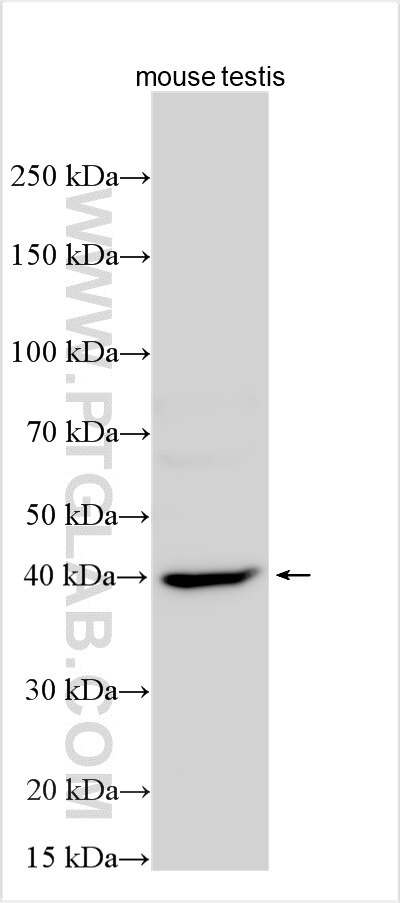
Geprüfte Anwendungen
| Erfolgreiche Detektion in WB | Maushodengewebe |
Empfohlene Verdünnung
| Anwendung | Verdünnung |
|---|---|
| Western Blot (WB) | WB : 1:500-1:3000 |
| It is recommended that this reagent should be titrated in each testing system to obtain optimal results. | |
| Sample-dependent, check data in validation data gallery | |
Produktinformation
30239-1-AP bindet in WB, ELISA USP50 und zeigt Reaktivität mit human, Maus
| Getestete Reaktivität | human, Maus |
| Wirt / Isotyp | Kaninchen / IgG |
| Klonalität | Polyklonal |
| Typ | Antikörper |
| Immunogen | USP50 fusion protein Ag31275 |
| Vollständiger Name | ubiquitin specific peptidase 50 |
| Berechnetes Molekulargewicht | 339 aa, 39 kDa |
| Beobachtetes Molekulargewicht | 40 kDa |
| GenBank-Zugangsnummer | BC146493 |
| Gene symbol | USP50 |
| Gene ID (NCBI) | 373509 |
| Konjugation | Unkonjugiert |
| Form | Liquid |
| Reinigungsmethode | Antigen-Affinitätsreinigung |
| Lagerungspuffer | PBS with 0.02% sodium azide and 50% glycerol |
| Lagerungsbedingungen | Bei -20°C lagern. Nach dem Versand ein Jahr lang stabil Aliquotieren ist bei -20oC Lagerung nicht notwendig. 20ul Größen enthalten 0,1% BSA. |
Hintergrundinformationen
USP50 (Ubiquitin Specific Peptidase 50) is a deubiquitinating enzyme that belongs to the USP family. It plays a key role in DNA replication, genome stability and cell cycle regulation. Recent studies have found that USP50 maintains the stability of the DNA replication process and telomere integrity by regulating the use of nuclease and deconjugating enzymes. During replication, USP50 was able to inhibit the harmful DNA2 nuclease activity and substitute the use of RecQ deconjugase, thereby preventing replication fork stalling and DNA damage. In addition, USP50 plays a role in the cell cycle G2/M phase transition, assembly of the NLRP3 inflammasome complex, and organization of nuclear speckles. Its loss of function leads to DNA double-strand breaks and telomere instability in cells under replication stress. These findings provide new insights into the understanding of the pathogenesis of genetic diseases and may offer potential targets for the treatment of diseases such as cancer and premature aging.
Protokolle
| PRODUKTSPEZIFISCHE PROTOKOLLE | |
|---|---|
| WB protocol for USP50 antibody 30239-1-AP | Protokoll herunterladen |
| STANDARD-PROTOKOLLE | |
|---|---|
| Klicken Sie hier, um unsere Standardprotokolle anzuzeigen |

