WDR33 Polyklonaler Antikörper
WDR33 Polyklonal Antikörper für WB, IP, Indirect ELISA
Wirt / Isotyp
Kaninchen / IgG
Getestete Reaktivität
human
Anwendung
WB, IP, Indirect ELISA
Konjugation
Unkonjugiert
Kat-Nr. : 22614-1-PBS
Synonyme
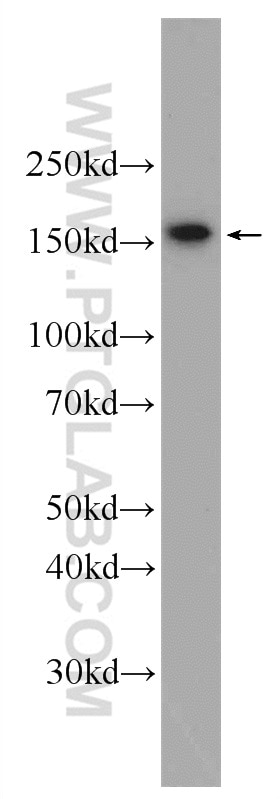
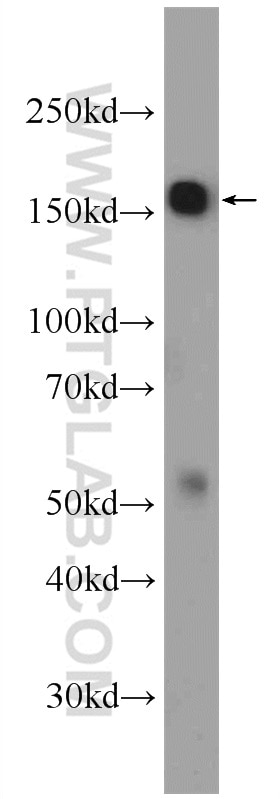
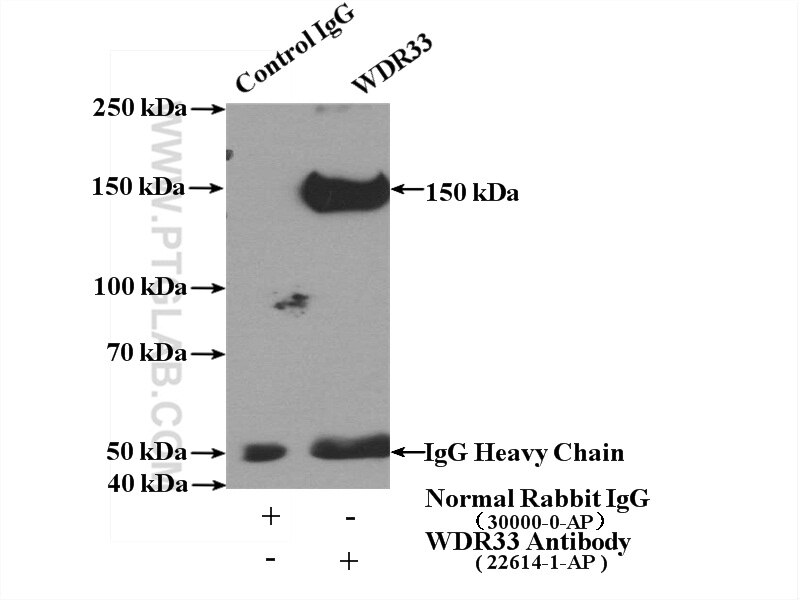
Geprüfte Anwendungen
Produktinformation
22614-1-PBS bindet in WB, IP, Indirect ELISA WDR33 und zeigt Reaktivität mit human
| Getestete Reaktivität | human |
| Wirt / Isotyp | Kaninchen / IgG |
| Klonalität | Polyklonal |
| Typ | Antikörper |
| Immunogen | WDR33 fusion protein Ag18382 |
| Vollständiger Name | WD repeat domain 33 |
| Berechnetes Molekulargewicht | 1336 aa, 146 kDa |
| Beobachtetes Molekulargewicht | 170 kDa |
| GenBank-Zugangsnummer | BC010283 |
| Gene symbol | WDR33 |
| Gene ID (NCBI) | 55339 |
| Konjugation | Unkonjugiert |
| Form | Liquid |
| Reinigungsmethode | Antigen-affinitätsgereinigt |
| Lagerungspuffer | PBS only |
| Lagerungsbedingungen | Store at -80°C. 20ul Größen enthalten 0,1% BSA. |
Hintergrundinformationen
WD repeat domain 33 (WDR33), also named WDC146, is a member of the WD repeat protein family. WD repeats are minimally conserved regions of approximately 40 amino acids typically bracketed by gly-his and trp-asp (GH-WD), which may facilitate formation of heterotrimeric or multiprotein complexes. Members of this family are involved in a variety of cellular processes, including cell cycle progression, signal transduction, apoptosis, and gene regulation. This gene is highly expressed in testis and the protein is localized to the nucleus. This gene may play important roles in the mechanisms of cytodifferentiation and/or DNA recombination.This gene encodes a member of the WD repeat protein family. WD repeats are minimally conserved regions of approximately 40 amino acids typically bracketed by gly-his and trp-asp (GH-WD), which may facilitate formation of heterotrimeric or multiprotein complexes. Members of this family are involved in a variety of cellular processes, including cell cycle progression, signal transduction, apoptosis, and gene regulation. This gene is highly expressed in testis and the protein is localized to the nucleus. This gene may play important roles in the mechanisms of cytodifferentiation and/or DNA recombination. Multiple alternatively spliced transcript variants encoding distinct isoforms have been found for this gene. This antibody recognizes the full length WDR33 protein.


