YKT6 Polyklonaler Antikörper
YKT6 Polyklonal Antikörper für WB, ELISA
Wirt / Isotyp
Kaninchen / IgG
Getestete Reaktivität
human, Ratte
Anwendung
WB, ELISA
Konjugation
Unkonjugiert
Kat-Nr. : 33685-1-AP
Synonyme
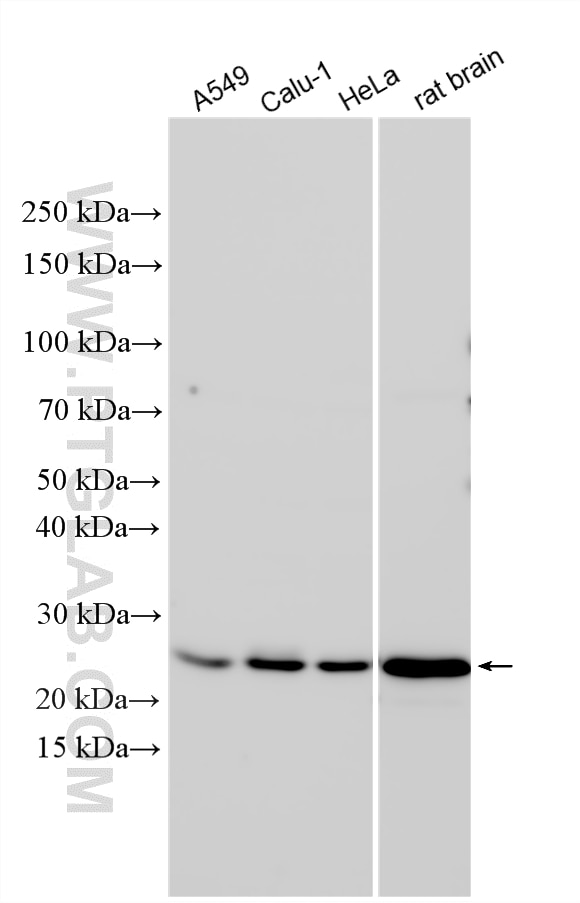
Geprüfte Anwendungen
| Erfolgreiche Detektion in WB | A549-Zellen, HeLa-Zellen, Rattenhirngewebe |
Empfohlene Verdünnung
| Anwendung | Verdünnung |
|---|---|
| Western Blot (WB) | WB : 1:1000-1:6000 |
| It is recommended that this reagent should be titrated in each testing system to obtain optimal results. | |
| Sample-dependent, check data in validation data gallery | |
Produktinformation
33685-1-AP bindet in WB, ELISA YKT6 und zeigt Reaktivität mit human, Ratten
| Getestete Reaktivität | human, Ratte |
| Wirt / Isotyp | Kaninchen / IgG |
| Klonalität | Polyklonal |
| Typ | Antikörper |
| Immunogen | YKT6 fusion protein Ag38740 |
| Vollständiger Name | YKT6 v-SNARE homolog (S. cerevisiae) |
| Berechnetes Molekulargewicht | 22 kDa |
| Beobachtetes Molekulargewicht | 25 kDa |
| GenBank-Zugangsnummer | BC007319 |
| Gene symbol | YKT6 |
| Gene ID (NCBI) | 10652 |
| Konjugation | Unkonjugiert |
| Form | Liquid |
| Reinigungsmethode | Antigen-Affinitätsreinigung |
| Lagerungspuffer | PBS with 0.02% sodium azide and 50% glycerol |
| Lagerungsbedingungen | Bei -20°C lagern. Nach dem Versand ein Jahr lang stabil Aliquotieren ist bei -20oC Lagerung nicht notwendig. 20ul Größen enthalten 0,1% BSA. |
Hintergrundinformationen
YKT6 is a soluble N-ethylmaleimide-sensitive factor attachment protein receptor (SNARE) that plays a central role in membrane fusion in eukaryotic cells. It is primarily localized in the cytoplasm and, through its unique dual lipidation modification (palmitoylation and farnesylation), can associate with various organelle membranes, such as the Golgi apparatus, endosomes, and vesicles. By forming stable trans-SNARE complexes with other SNARE proteins (e.g., Syntaxin and SNAP-25 family members) on target membranes, YKT6 provides the driving force for membrane fusion, thereby facilitating intracellular trafficking. This protein is essential for maintaining organelle integrity, autophagy, and secretory pathways. Studies have shown that dysfunction of YKT6 is associated with various diseases, including cancer, neurodegenerative disorders, and metabolic abnormalities, making it a potential target for drug development.
Protokolle
| PRODUKTSPEZIFISCHE PROTOKOLLE | |
|---|---|
| WB protocol for YKT6 antibody 33685-1-AP | Protokoll herunterladen |
| STANDARD-PROTOKOLLE | |
|---|---|
| Klicken Sie hier, um unsere Standardprotokolle anzuzeigen |

