Anticorps Polyclonal de lapin anti-ABL1
ABL1 Polyclonal Antibody for WB, Indirect ELISA
Hôte / Isotype
Lapin / IgG
Réactivité testée
Humain
Applications
WB, Indirect ELISA
Conjugaison
Non conjugué
N° de cat : 29725-1-PBS
Synonymes
Galerie de données de validation
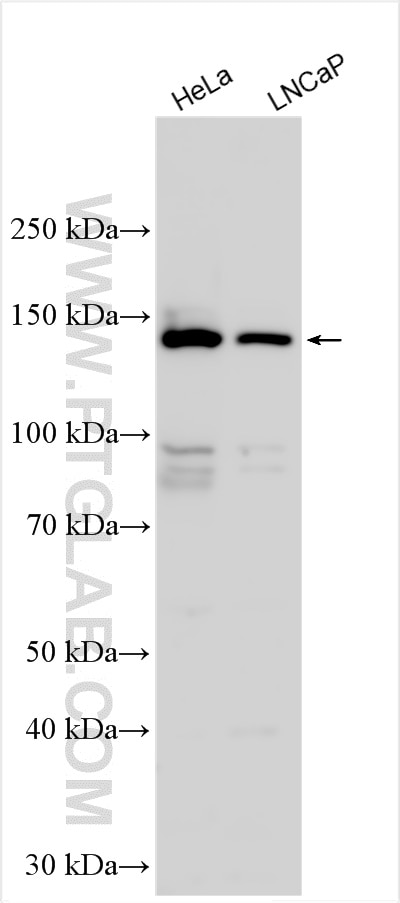
Informations sur le produit
29725-1-PBS cible ABL1 dans les applications de WB, Indirect ELISA et montre une réactivité avec des échantillons Humain
| Réactivité | Humain |
| Hôte / Isotype | Lapin / IgG |
| Clonalité | Polyclonal |
| Type | Anticorps |
| Immunogène | Peptide |
| Nom complet | c-abl oncogene 1, receptor tyrosine kinase |
| Masse moléculaire calculée | 1149 aa, 125 kDa |
| Poids moléculaire observé | 140 kDa |
| Numéro d’acquisition GenBank | BC117451 |
| Symbole du gène | ABL1 |
| Identification du gène (NCBI) | 25 |
| Conjugaison | Non conjugué |
| Forme | Liquide |
| Méthode de purification | Purification par affinité contre l'antigène |
| Tampon de stockage | PBS only |
| Conditions de stockage | Store at -80°C. 20ul contiennent 0,1% de BSA. |
Informations générales
ABL1, also named as ABL, JTK7, c-ABL and p150, belongs to the protein kinase superfamily, Tyr protein kinase family and ABL subfamily. ABL1 regulates cytoskeleton remodeling during cell differentiation, cell division and cell adhesion. ABL1 localizes to dynamic actin structures, and phosphorylates CRK and CRKL, DOK1, and other proteins controlling cytoskeleton dynamics. It regulates DNA repair potentially by activating the proapoptotic pathway when the DNA damage is too severe to be repaired. ABL1 catalyze the reaction: ATP + a [protein]-L-tyrosine = ADP + a [protein]-L-tyrosine phosphate. A chromosomal aberration involving ABL1 is a cause of chronic myeloid leukemia (CML) [MIM:608232]. Translocation t(9;22)(q34;q11) with BCR. The translocation produces a BCR-ABL found also in acute myeloid leukemia (AML) and acute lymphoblastic leukemia (ALL).


