- Phare
- Validé par KD/KO
Anticorps Monoclonal anti-ANLN
ANLN Monoclonal Antibody for WB, IF/ICC, ELISA
Hôte / Isotype
Mouse / IgG1
Réactivité testée
Humain, rat, souris
Applications
WB, IF/ICC, ELISA
Conjugaison
Non conjugué
CloneNo.
1B4A8
N° de cat : 66643-1-PBS
Synonymes
Galerie de données de validation
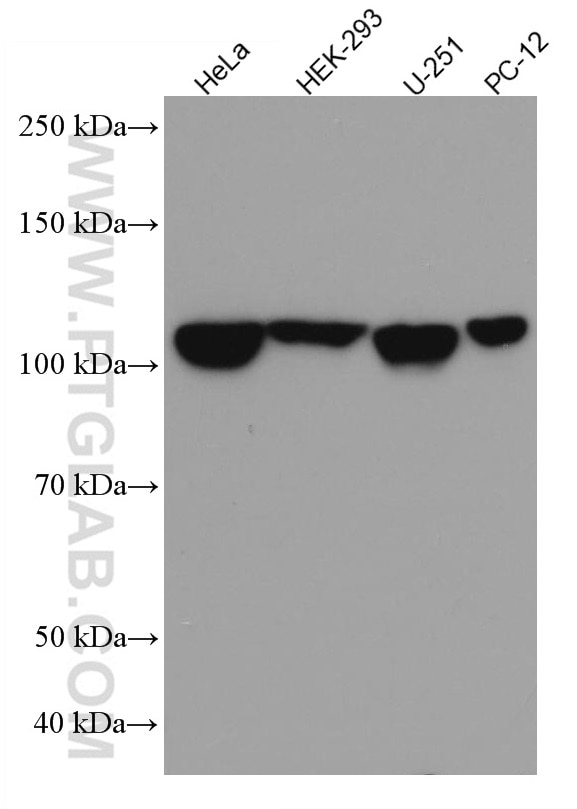
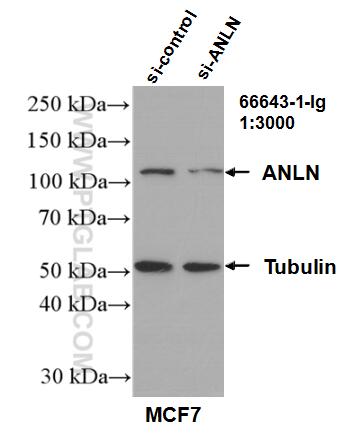
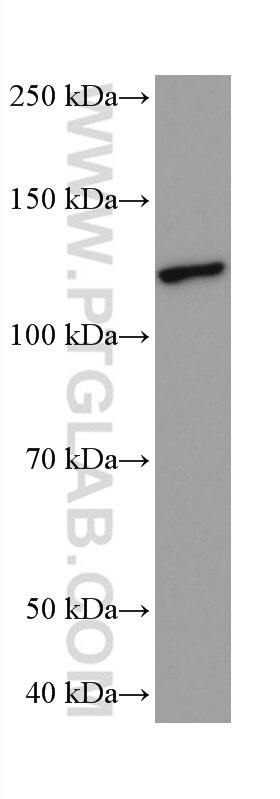
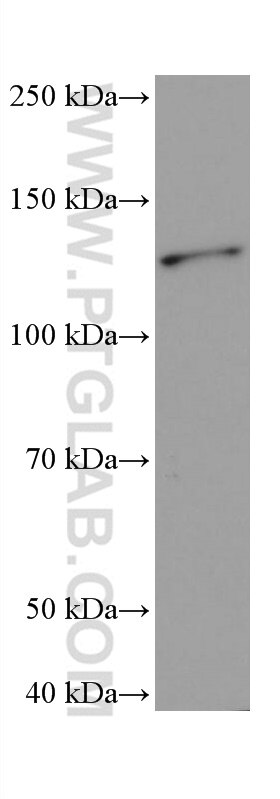

Informations sur le produit
66643-1-PBS cible ANLN dans les applications de WB, IF/ICC, ELISA et montre une réactivité avec des échantillons Humain, rat, souris
| Réactivité | Humain, rat, souris |
| Hôte / Isotype | Mouse / IgG1 |
| Clonalité | Monoclonal |
| Type | Anticorps |
| Immunogène | ANLN Protéine recombinante Ag19294 |
| Nom complet | anillin, actin binding protein |
| Masse moléculaire calculée | 1124 aa, 124 kDa |
| Poids moléculaire observé | 110 kDa~120 kDa |
| Numéro d’acquisition GenBank | BC034692 |
| Symbole du gène | ANLN |
| Identification du gène (NCBI) | 54443 |
| Conjugaison | Non conjugué |
| Forme | Liquide |
| Méthode de purification | Purification par protéine G |
| Tampon de stockage | PBS only |
| Conditions de stockage | Store at -80°C. 20ul contiennent 0,1% de BSA. |
Informations générales
Anillin, an actin-binding protein, is a conserved cleavage furrow component important for cytokinesis. The human anillin protein localizes to the nucleus during interphase, the cortex following nuclear envelope breakdown, and the cleavage furrow during cytokinesis. It interactions with at least two other furrow proteins, actin and the septins through its C-terminal PH domain and N-terminal actin-binding domain. In anillin knockdown cells, the cleavage furrow ingressed but failed to complete the ingression. Anillin has been found to be overexpressed in tumors and may serve as promising marker for pancreatic carcinoma molecular diagnostics as well as a prognostic indicator for non-small cell lung cancers.


