Anticorps Polyclonal de lapin anti-APBB1
APBB1 Polyclonal Antibody for WB, IP, ELISA
Hôte / Isotype
Lapin / IgG
Réactivité testée
Humain, rat, souris
Applications
WB, IP, ELISA
Conjugaison
Non conjugué
N° de cat : 27874-1-AP
Synonymes
Galerie de données de validation
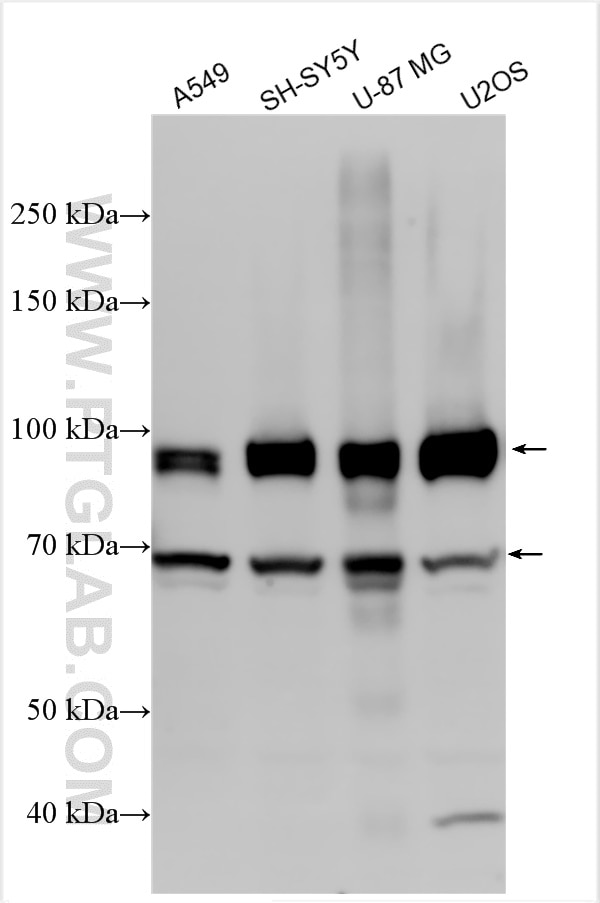
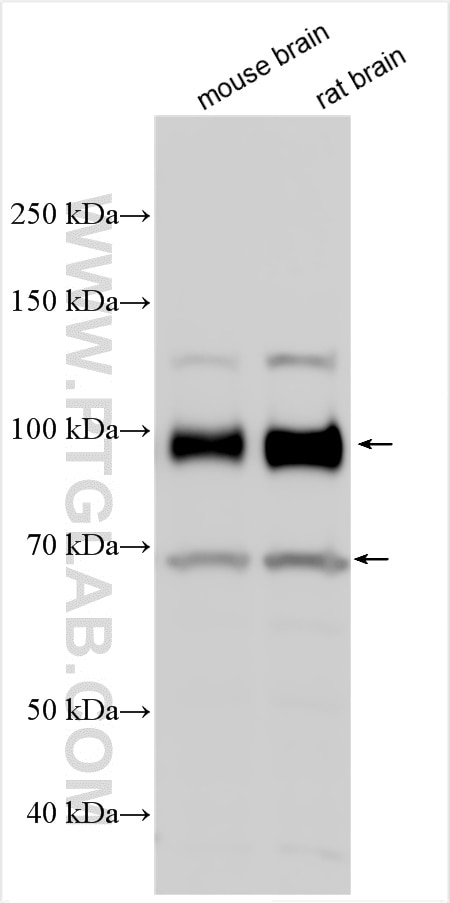
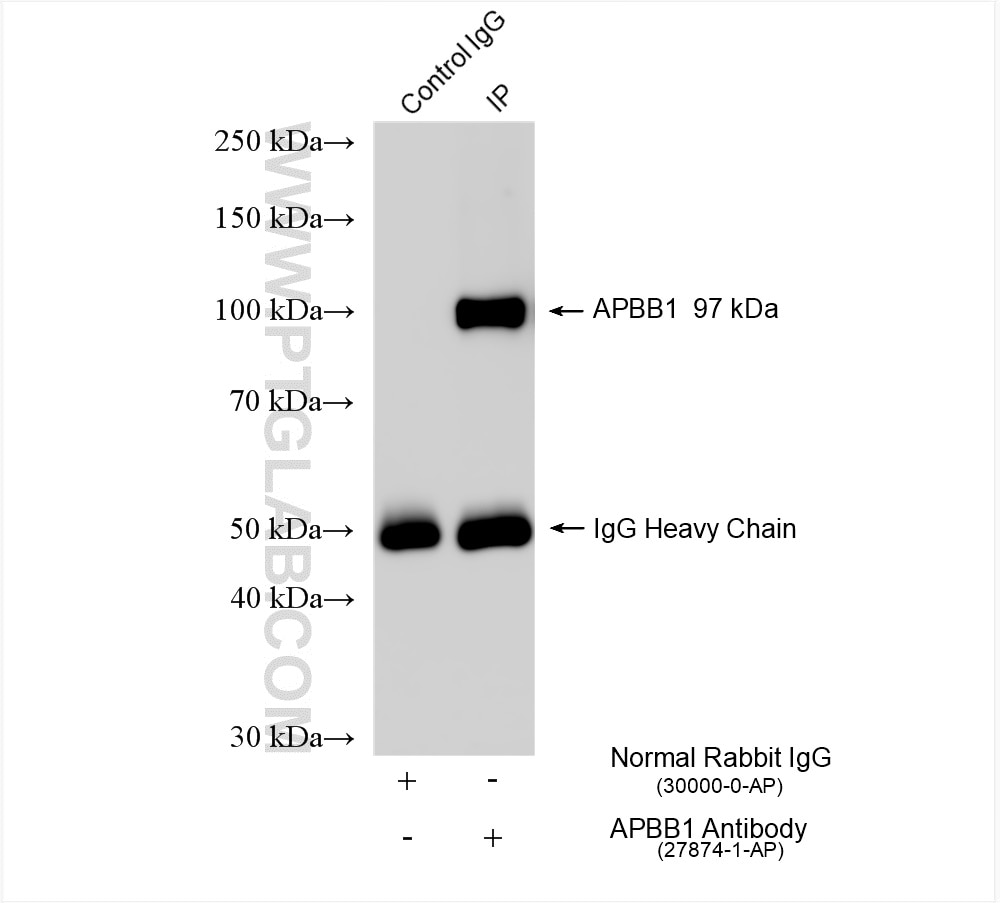
Applications testées
| Résultats positifs en WB | cellules A549, cellules MG U-87, cellules SH-SY5Y, cellules U2OS, tissu cérébral de rat, tissu cérébral de souris |
| Résultats positifs en IP | tissu cérébral de souris, |
Dilution recommandée
| Application | Dilution |
|---|---|
| Western Blot (WB) | WB : 1:1000-1:6000 |
| Immunoprécipitation (IP) | IP : 0.5-4.0 ug for 1.0-3.0 mg of total protein lysate |
| It is recommended that this reagent should be titrated in each testing system to obtain optimal results. | |
| Sample-dependent, check data in validation data gallery | |
Informations sur le produit
27874-1-AP cible APBB1 dans les applications de WB, IP, ELISA et montre une réactivité avec des échantillons Humain, rat, souris
| Réactivité | Humain, rat, souris |
| Hôte / Isotype | Lapin / IgG |
| Clonalité | Polyclonal |
| Type | Anticorps |
| Immunogène | APBB1 Protéine recombinante Ag27434 |
| Nom complet | amyloid beta (A4) precursor protein-binding, family B, member 1 (Fe65) |
| Masse moléculaire calculée | 708 aa, 77 kDa |
| Poids moléculaire observé | 65 kDa, 97 kDa |
| Numéro d’acquisition GenBank | BC010854 |
| Symbole du gène | APBB1 |
| Identification du gène (NCBI) | 322 |
| Conjugaison | Non conjugué |
| Forme | Liquide |
| Méthode de purification | Purification par affinité contre l'antigène |
| Tampon de stockage | PBS with 0.02% sodium azide and 50% glycerol |
| Conditions de stockage | Stocker à -20°C. Stable pendant un an après l'expédition. L'aliquotage n'est pas nécessaire pour le stockage à -20oC Les 20ul contiennent 0,1% de BSA. |
Informations générales
Adaptor protein FE65 (APBB1) specifically binds to the intracellular tail of the type I transmembrane protein, β-amyloid precursor protein (APP). FE65 is a multimodular adaptor protein, consisting of three major protein-protein interaction domains, a WW domain and two phosphotyrosine interaction domains (PID). The interaction between FE65 and APP mainly takes place between the C-terminal PID (PID2) and the APP intracellular domain (AICD) (PMID: 15647266). There is novel evidence that the major isoform of FE65 (97-kDa FE65, p97FE65) can be converted to a 65-kDa N-terminally truncated C-terminal fragment (p65FE65) via endoproteolysis. The cleavage region locates immediately after an acidic residue cluster but before the three major protein-protein binding domains (PMID: 15647266). FE65 is predominantly expressed in central nervous system neurons, and its expression is regulated during development and aging, with high levels corresponding to the timing of neural tissue formation and high neuronal activity (PMID: 7867517, PMID: 10561691, PMID: 14689444). p65FE65 (65kDa) is endoproteolytically cleaved from p97FE65 (97 kDa), the major isoform of FE65 (97-kDa FE65, p97FE65) can be converted to a 65-kDa N-terminally truncated C-terminal fragment (p65FE65) via endoproteolysis (PMID: 15647266).
Protocole
| Product Specific Protocols | |
|---|---|
| WB protocol for APBB1 antibody 27874-1-AP | Download protocol |
| IP protocol for APBB1 antibody 27874-1-AP | Download protocol |
| Standard Protocols | |
|---|---|
| Click here to view our Standard Protocols |

