Anticorps Recombinant de lapin anti-CASR
CASR Recombinant Antibody for WB, Indirect ELISA
Hôte / Isotype
Lapin / IgG
Réactivité testée
Humain, souris
Applications
WB, Indirect ELISA
Conjugaison
Non conjugué
CloneNo.
243029B11
N° de cat : 86319-1-PBS
Synonymes
Galerie de données de validation
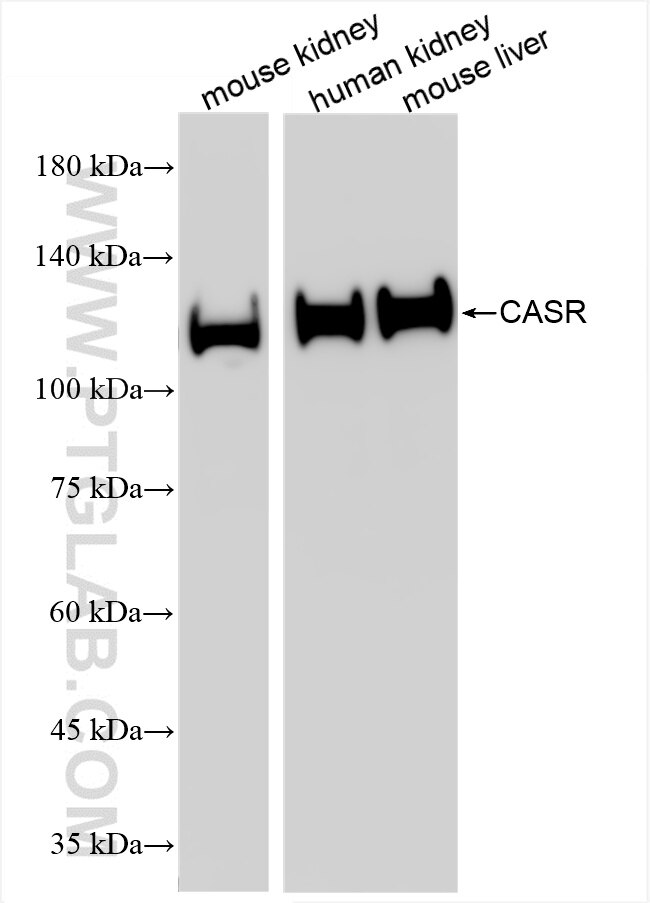
Informations sur le produit
86319-1-PBS cible CASR dans les applications de WB, Indirect ELISA et montre une réactivité avec des échantillons Humain, souris
| Réactivité | Humain, souris |
| Hôte / Isotype | Lapin / IgG |
| Clonalité | Recombinant |
| Type | Anticorps |
| Immunogène | Peptide |
| Nom complet | calcium-sensing receptor |
| Masse moléculaire calculée | 121 kDa |
| Poids moléculaire observé | 120 kDa |
| Numéro d’acquisition GenBank | NM_000388 |
| Symbole du gène | Calcium Sensing Receptor |
| Identification du gène (NCBI) | 846 |
| Conjugaison | Non conjugué |
| Forme | Liquide |
| Méthode de purification | Purification par protéine A |
| Tampon de stockage | PBS only |
| Conditions de stockage | Store at -80°C. 20ul contiennent 0,1% de BSA. |
Informations générales
CASR, also named as GPRC2A, PCAR1, belongs to the G-protein coupled receptor 3 family. Changes in extracellular calcium are thought to modulate a balance between proliferation and differentiation in a variety of cell types. The activity of CASR is mediated by a G-protein that activates a phosphatidylinositol-calcium second messenger system. It has been shown to play a major role in regulating parathyroid hormone secretion and subsequently influencing the calcium concentration of extracellular fluids. In normal primary keratinocytes and breast epithelial cells, proliferation is inhibited and elevated extracellular calcium levels trigger differentiation. Malignant transformations of these cell types are accompanied by a loss of responsiveness to the anti-proliferative effects of elevated extracellular calcium. Several disorders of calcium homeostasis have been linked to mutations in the CaSR. These include familial hypocalciuric hypercalcemia (FHH), neonatal severe hyperparathyroidism (NSHPT), and autosomal dominant hypocalemia (ADHypo).


