Anticorps Recombinant de lapin anti-CCL7/MCP-3
CCL7/MCP-3 Recombinant Antibody for FC (Intra)
Hôte / Isotype
Lapin / IgG
Réactivité testée
souris
Applications
FC (Intra)
Conjugaison
Non conjugué
CloneNo.
250662G6
N° de cat : 98555-1-RR
Synonymes
Galerie de données de validation
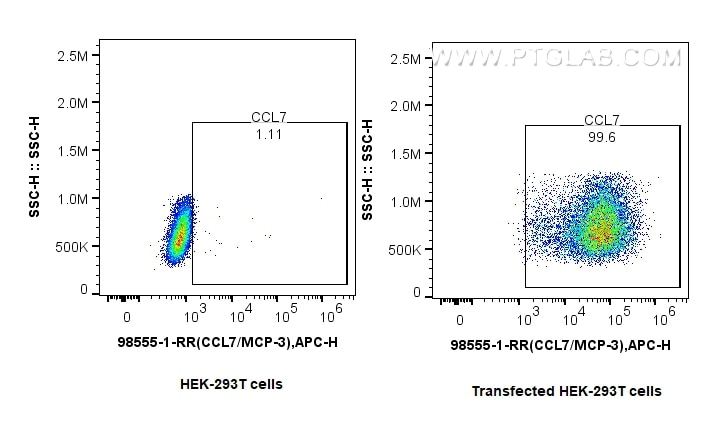
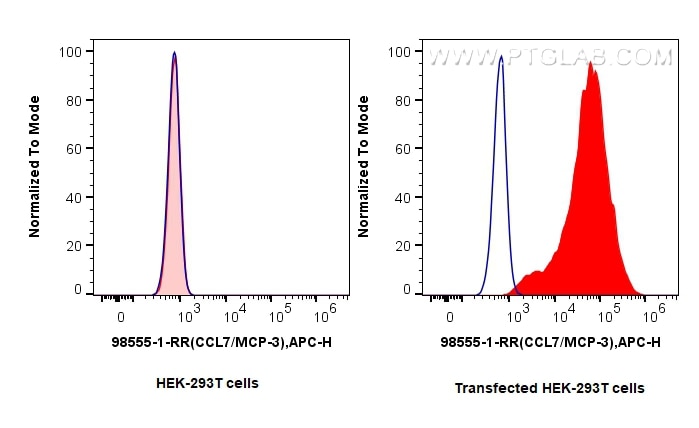
Applications testées
| Résultats positifs en FC (Intra) | Transfected HEK-293T cells, |
Dilution recommandée
| Application | Dilution |
|---|---|
| This reagent has been tested for flow cytometric analysis. It is recommended that this reagent should be titrated in each testing system to obtain optimal results. | |
| Sample-dependent, check data in validation data gallery | |
Informations sur le produit
98555-1-RR cible CCL7/MCP-3 dans les applications de FC (Intra) et montre une réactivité avec des échantillons souris
| Réactivité | souris |
| Hôte / Isotype | Lapin / IgG |
| Clonalité | Recombinant |
| Type | Anticorps |
| Immunogène | CCL7/MCP-3 Protéine recombinante Eg4626 |
| Nom complet | chemokine (C-C motif) ligand 7 |
| Masse moléculaire calculée | 11kDa |
| Numéro d’acquisition GenBank | NM_013654.3 |
| Symbole du gène | Ccl7 |
| Identification du gène (NCBI) | 20306 |
| Conjugaison | Non conjugué |
| Forme | Liquide |
| Méthode de purification | Purification par protéine A |
| Tampon de stockage | PBS with 0.09% sodium azide |
| Conditions de stockage | Store at 2 - 8°C. Stable for one year after shipment. |
Informations générales
The chemokine CCL7 (MCP3) is a chemotactic factor and potent attractant of monocytes firstly characterized from the culture supernatants of MG-63 osteosarcoma cells. CCL7 is known to promote the recruitment of many innate immune cell types including monocytes and neutrophils to sites of bacterial and viral infection and eosinophils and basophils to sites of allergic inflammation. CCL7 is expressed at low levels in endothelial cells, fibroblasts and mononuclear cells and upregulated by various stimuli including viruses, type I or type II interferons (IFNs). CCL7 (MCP-3) mediates effects on a host of innate and adaptive immune cell types through binding to numerous receptors including CCR1, CCR2, CCR3, CCR5, and CCR10.

