Anticorps Polyclonal de lapin anti-CD158K/KIR3DL2
CD158K/KIR3DL2 Polyclonal Antibody for WB, ELISA
Hôte / Isotype
Lapin / IgG
Réactivité testée
Humain, souris
Applications
Conjugaison
Non conjugué
N° de cat : 33010-1-AP
Synonymes
Galerie de données de validation
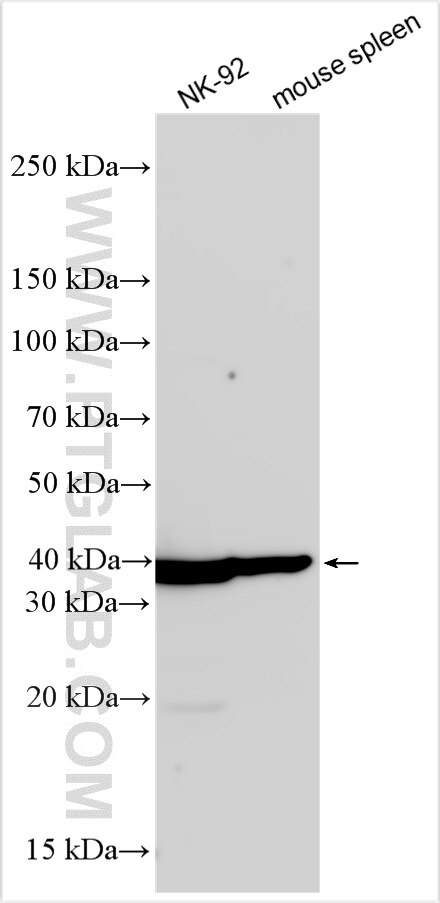
Applications testées
| Résultats positifs en WB | NK-92 cells, tissu splénique de souris |
Dilution recommandée
| Application | Dilution |
|---|---|
| Western Blot (WB) | WB : 1:1000-1:8000 |
| It is recommended that this reagent should be titrated in each testing system to obtain optimal results. | |
| Sample-dependent, check data in validation data gallery | |
Informations sur le produit
33010-1-AP cible CD158K/KIR3DL2 dans les applications de et montre une réactivité avec des échantillons Humain, souris
| Réactivité | Humain, souris |
| Hôte / Isotype | Lapin / IgG |
| Clonalité | Polyclonal |
| Type | Anticorps |
| Immunogène | CD158K/KIR3DL2 Protéine recombinante Eg4355 |
| Nom complet | killer cell immunoglobulin-like receptor, three domains, long cytoplasmic tail, 2 |
| Masse moléculaire calculée | 50 kDa |
| Poids moléculaire observé | 50-60 kda |
| Numéro d’acquisition GenBank | NM_006737.4 |
| Symbole du gène | KIR3DL2 |
| Identification du gène (NCBI) | 3812 |
| Conjugaison | Non conjugué |
| Forme | Liquide |
| Méthode de purification | Purification par affinité contre l'antigène |
| Tampon de stockage | PBS with 0.02% sodium azide and 50% glycerol |
| Conditions de stockage | Stocker à -20°C. Stable pendant un an après l'expédition. L'aliquotage n'est pas nécessaire pour le stockage à -20oC Les 20ul contiennent 0,1% de BSA. |
Informations générales
KIR3DL2, also known as CD158k, is an inhibitory receptor expressed by natural killer (NK) cells and a subset of CD8+ T cells. It plays a role in immune regulation by binding to HLA class I molecules, specifically HLA-A3 and HLA-A11, in a peptide-dependent fashion. KIR3DL2 can also function as an innate immune receptor for delivering CpG DNA to TLR9 in NK cells, highlighting its role in both adaptive and innate immunity. This protein is primarily expressed on the cell surface, particularly in NK cells and certain T cells. It has been implicated in various diseases, particularly in the context of hematological malignancies and autoimmune diseases. Aberrant expression of KIR3DL2 has been observed in neoplastic cells in transformed mycosis fungoides and Sézary syndrome, suggesting its potential as a therapeutic target in primary cutaneous anaplastic large-cell lymphoma (pcALCL).
Protocole
| Product Specific Protocols | |
|---|---|
| WB protocol for CD158K/KIR3DL2 antibody 33010-1-AP | Download protocol |
| Standard Protocols | |
|---|---|
| Click here to view our Standard Protocols |

