Anticorps Recombinant de lapin anti-CD6
CD6 Recombinant Antibody for FC
Hôte / Isotype
Lapin / IgG
Réactivité testée
Humain
Applications
FC
Conjugaison
Non conjugué
CloneNo.
241965C9
N° de cat : 98223-1-RR
Synonymes
Galerie de données de validation
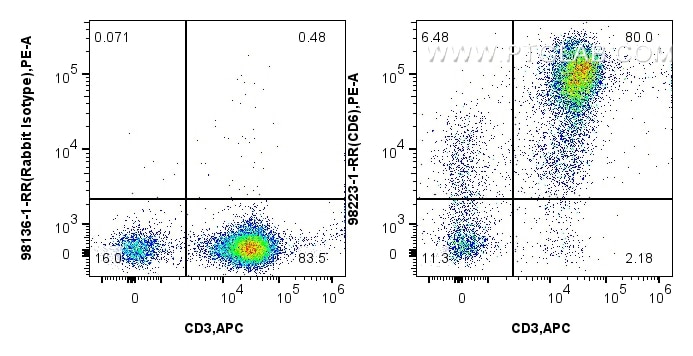
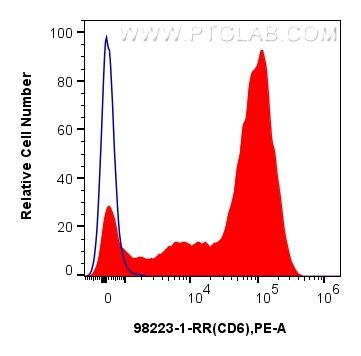
Applications testées
| Résultats positifs en cytométrie | CMSP humaines, |
Dilution recommandée
| Application | Dilution |
|---|---|
| This reagent has been tested for flow cytometric analysis. It is recommended that this reagent should be titrated in each testing system to obtain optimal results. | |
| Sample-dependent, check data in validation data gallery | |
Informations sur le produit
98223-1-RR cible CD6 dans les applications de FC et montre une réactivité avec des échantillons Humain
| Réactivité | Humain |
| Hôte / Isotype | Lapin / IgG |
| Clonalité | Recombinant |
| Type | Anticorps |
| Immunogène | CD6 Protéine recombinante Eg2079 |
| Nom complet | CD6 molecule |
| Numéro d’acquisition GenBank | BC033755 |
| Symbole du gène | CD6 |
| Identification du gène (NCBI) | 923 |
| Conjugaison | Non conjugué |
| Forme | Liquide |
| Méthode de purification | Protein A purfication |
| Tampon de stockage | PBS with 0.09% sodium azide |
| Conditions de stockage | Store at 2 - 8°C. Stable for one year after shipment. |
Informations générales
CD6 is a type I transmembrane glycoprotein that belongs to the scavenger receptor cysteine-rich superfamily (PMID: 21880988). It is composed of an extracellular region, which consists of three tandem SRCR domains, a transmembrane region, and a cytoplasmic tail devoid of intrinsic catalytic activity but harboring several phosphorylatable residues suitable for intracellular signal transduction (PMID: 38139340; 23711376). CD6 is expressed by T cells, medullary thymocytes, a subset of B cells and NK cells, and in some cells of the brain (PMID: 1919444; 21178331). CD6 plays a role in lymphocyte activation, proliferation, and survival processes via interaction with its endogenous ligands.
Protocole
| Product Specific Protocols | |
|---|---|
| FC protocol for CD6 antibody 98223-1-RR | Download protocol |
| Standard Protocols | |
|---|---|
| Click here to view our Standard Protocols |

