Anticorps Polyclonal de lapin anti-CNGA2
CNGA2 Polyclonal Antibody for WB, Indirect ELISA
Hôte / Isotype
Lapin / IgG
Réactivité testée
Humain, rat, souris
Applications
WB, Indirect ELISA
Conjugaison
Non conjugué
N° de cat : 23823-1-PBS
Synonymes
Galerie de données de validation
Informations sur le produit
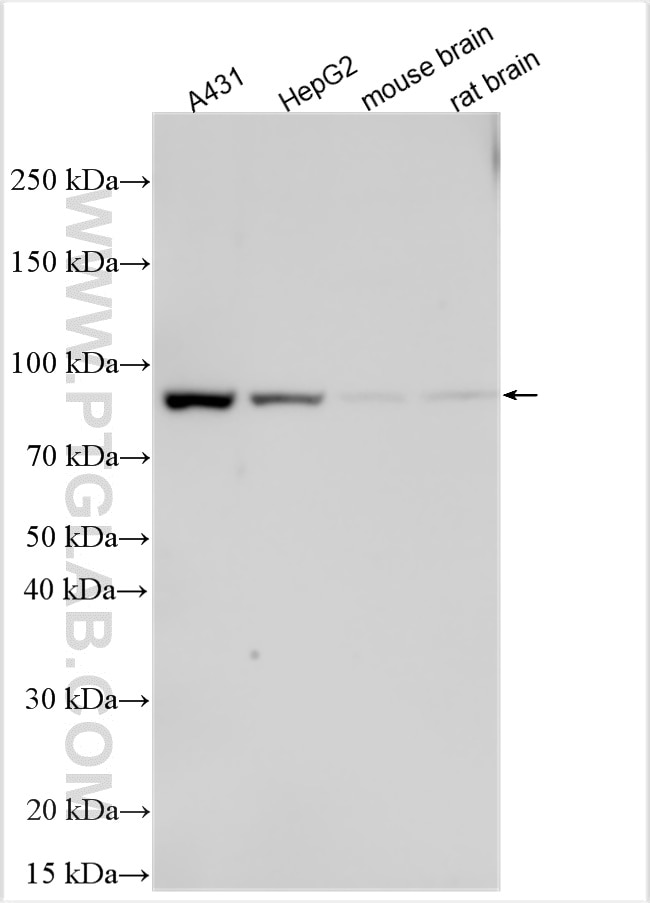
23823-1-PBS cible CNGA2 dans les applications de WB, Indirect ELISA et montre une réactivité avec des échantillons Humain, rat, souris
| Réactivité | Humain, rat, souris |
| Hôte / Isotype | Lapin / IgG |
| Clonalité | Polyclonal |
| Type | Anticorps |
| Immunogène | CNGA2 Protéine recombinante Ag19899 |
| Nom complet | cyclic nucleotide gated channel alpha 2 |
| Masse moléculaire calculée | 664 aa, 76 kDa |
| Poids moléculaire observé | 80 kDa |
| Numéro d’acquisition GenBank | BC126302 |
| Symbole du gène | CNGA2 |
| Identification du gène (NCBI) | 1260 |
| Conjugaison | Non conjugué |
| Forme | Liquide |
| Méthode de purification | Purifié par affinité contre l'antigène |
| Tampon de stockage | PBS only |
| Conditions de stockage | Store at -80°C. 20ul contiennent 0,1% de BSA. |
Informations générales
Cyclic nucleotide-gated (CNG) channels are crucial for visual and olfactory transductions (PMID: 12432397). Native CNG channels are heterotetramers composed of homologous A and B subunits. The olfactory CNG channels are composed of two CNGA2 subunits, one CNGA4 and one CNGB1b subunit, each containing a cyclic nucleotide-binding domain (PMID: 22786723). CNGA2, also named as CNCA, CNCA1 and CNCG2, is the primary subunit of the olfactory CNG channel. Odorant signal transduction is probably mediated by a G-protein coupled cascade using cAMP as second messenger. Activation of olfactory channel by cyclic nucleotides leads to a depolarization of olfactory sensory neurons.


