Anticorps Polyclonal de lapin anti-DHH
DHH Polyclonal Antibody for WB, Indirect ELISA
Hôte / Isotype
Lapin / IgG
Réactivité testée
Humain, rat, souris
Applications
WB, Indirect ELISA
Conjugaison
Non conjugué
N° de cat : 13889-1-PBS
Synonymes
Galerie de données de validation
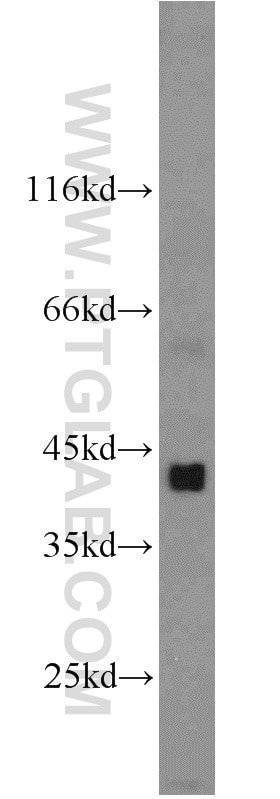
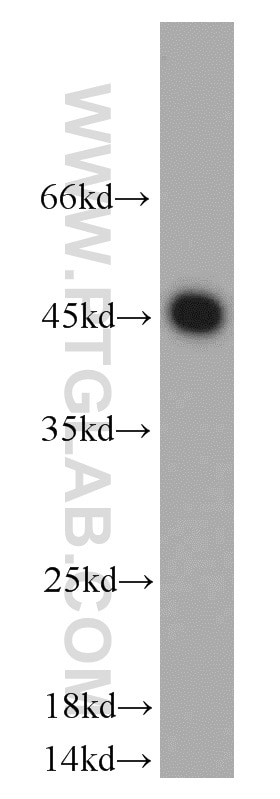
Informations sur le produit
13889-1-PBS cible DHH dans les applications de WB, Indirect ELISA et montre une réactivité avec des échantillons Humain, rat, souris
| Réactivité | Humain, rat, souris |
| Hôte / Isotype | Lapin / IgG |
| Clonalité | Polyclonal |
| Type | Anticorps |
| Immunogène | DHH Protéine recombinante Ag4850 |
| Nom complet | desert hedgehog homolog (Drosophila) |
| Masse moléculaire calculée | 396 aa, 44 kDa |
| Poids moléculaire observé | 42 kDa |
| Numéro d’acquisition GenBank | BC033507 |
| Symbole du gène | DHH |
| Identification du gène (NCBI) | 50846 |
| Conjugaison | Non conjugué |
| Forme | Liquide |
| Méthode de purification | Purification par affinité contre l'antigène |
| Tampon de stockage | PBS only |
| Conditions de stockage | Store at -80°C. 20ul contiennent 0,1% de BSA. |
Informations générales
Desert hedgehog (DHH) is one of three ligands in the hedgehog signaling pathway that controls gonad
morphogenesis and nerve perineurium differentiation.
What is the molecular weight of DHH? Is DHH post-translationally modified?
DHH protein is synthesized in a precursor form of ~45 kDa. Hedgehog proteins contain a small N-terminal signal
peptide, which is cleaved off intracellularly, leading to 39 kDa species. Hedgehog proteins are then subject to
autoproteolysis, which leads to the generation of a 19 kDa N-terminal fragment with added cholesterol moiety
and a 25 kDa C-terminal fragment (PMID: 7985023). The C-terminal fragment catalyzes the precursor proteolysis,
while the N-terminal fragment gets secreted from cells and acts as an active ligand in the hedgehog signaling
pathway.
What is the subcellular localization of DHH?
DHH protein is subject to autoproteolysis, as described above, and the N-terminal fragment is secreted from
cells in a regulated manner. The amounts of extracellular hedgehog proteins determine local and long-range
signaling (PMID: 7736596 and 7885476).
What is the tissue expression pattern of DHH?
Unlike other hedgehog ligands, expression of DHH is very tissue-specific. DHH is strongly expressed in Steroli
cell precursors, adult sterol cells, and in Leydig cells in testis (PMID: 8805249, 12050120) but also in granulosa
cells in ovaries (PMID: 15878962), as well as in Schwann cells-glia of the peripheral nervous system
(PMID: 7589793).
What is the role of DHH in morphogenesis?
DHH plays a role in the correct development of male gonads and perineurium. Loss of DHH leads to peripheral
neuropathy and gonadal dysgenesis (PMID: 11017805).


