Anticorps Polyclonal de lapin anti-DR5-Specific
DR5-Specific Polyclonal Antibody for WB, Indirect ELISA
Hôte / Isotype
Lapin / IgG
Réactivité testée
Humain
Applications
WB, Indirect ELISA
Conjugaison
Non conjugué
N° de cat : 15497-1-PBS
Synonymes
Galerie de données de validation
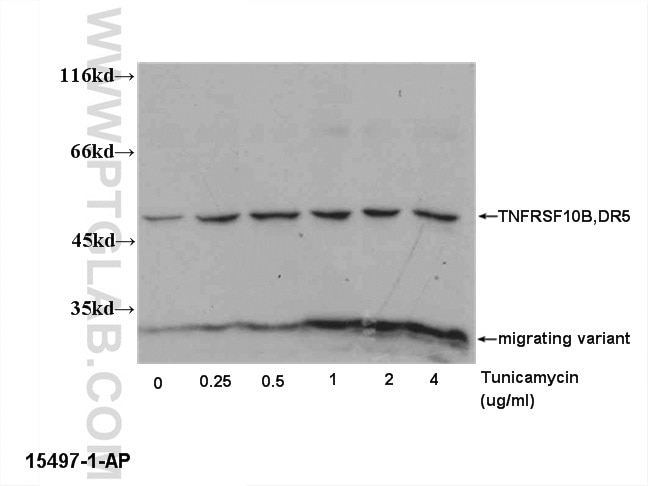
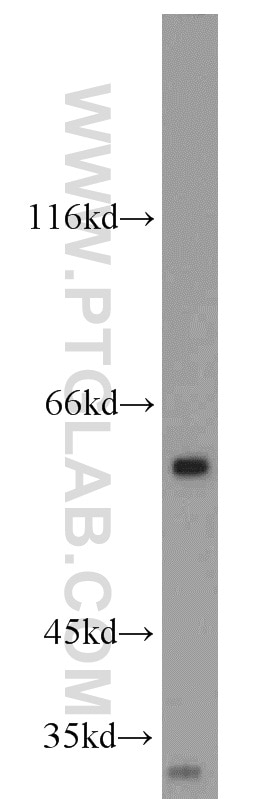
Informations sur le produit
15497-1-PBS cible DR5-Specific dans les applications de WB, Indirect ELISA et montre une réactivité avec des échantillons Humain
| Réactivité | Humain |
| Hôte / Isotype | Lapin / IgG |
| Clonalité | Polyclonal |
| Type | Anticorps |
| Immunogène | Peptide |
| Nom complet | tumor necrosis factor receptor superfamily, member 10b |
| Masse moléculaire calculée | 48 kDa |
| Poids moléculaire observé | 58-60 kDa, 45-50 kDa, 32 kDa |
| Numéro d’acquisition GenBank | NM_003842 |
| Symbole du gène | DR5 |
| Identification du gène (NCBI) | 8795 |
| Conjugaison | Non conjugué |
| Forme | Liquide |
| Méthode de purification | Purification par affinité contre l'antigène |
| Tampon de stockage | PBS only |
| Conditions de stockage | Store at -80°C. 20ul contiennent 0,1% de BSA. |
Informations générales
TNFRSF10B, also known as CD262, DR5, TRAILR2, TRICK2 and KILLER, is a widely expressed single-pass type I membrane protein belonging to the tumour necrosis factor receptor superfamily (TNFRSF). It is a receptor for TNF-related apoptosis-inducing ligand (TRAIL), which is a member of the tumor necrosis factor (TNF) family of cytokines and induces apoptosis in a wide variety of cells (PMID: 9311998). TNFRSF10B contains two extracellular cysteine-rich repeats, typical for TNF receptor (TNFR) family members, and a cytoplasmic death domain (DD), through which TNFRSF10B is capable to transmit the apoptotic signal (PMID: 9311998; 20531300). In PDAC cells, especially Panc89 cells, it expresses additionally to the approximately 48 and 40 kDa forms of DR5, a faster migrating variant of DR5 of about 32 kDa(PMID:20354842). The TRAIL receptor 2 (death receptor 5, or DR5) forms receptor dimers in a ligand-dependent manner, and these receptor dimers exist within high molecular weight networks(Dr. Jonathan N. Sachs,2012).


