Anticorps Recombinant de lapin anti-Di/Tri-Methyl-Histone H3 (Lys36)
Di/Tri-Methyl-Histone H3 (Lys36) Recombinant Antibody for IF/ICC
Hôte / Isotype
Lapin / IgG
Réactivité testée
Humain
Applications
IF/ICC
Conjugaison
CoraLite® Plus 488 Fluorescent Dye
CloneNo.
241139G6
N° de cat : CL488-84329
Synonymes
Galerie de données de validation
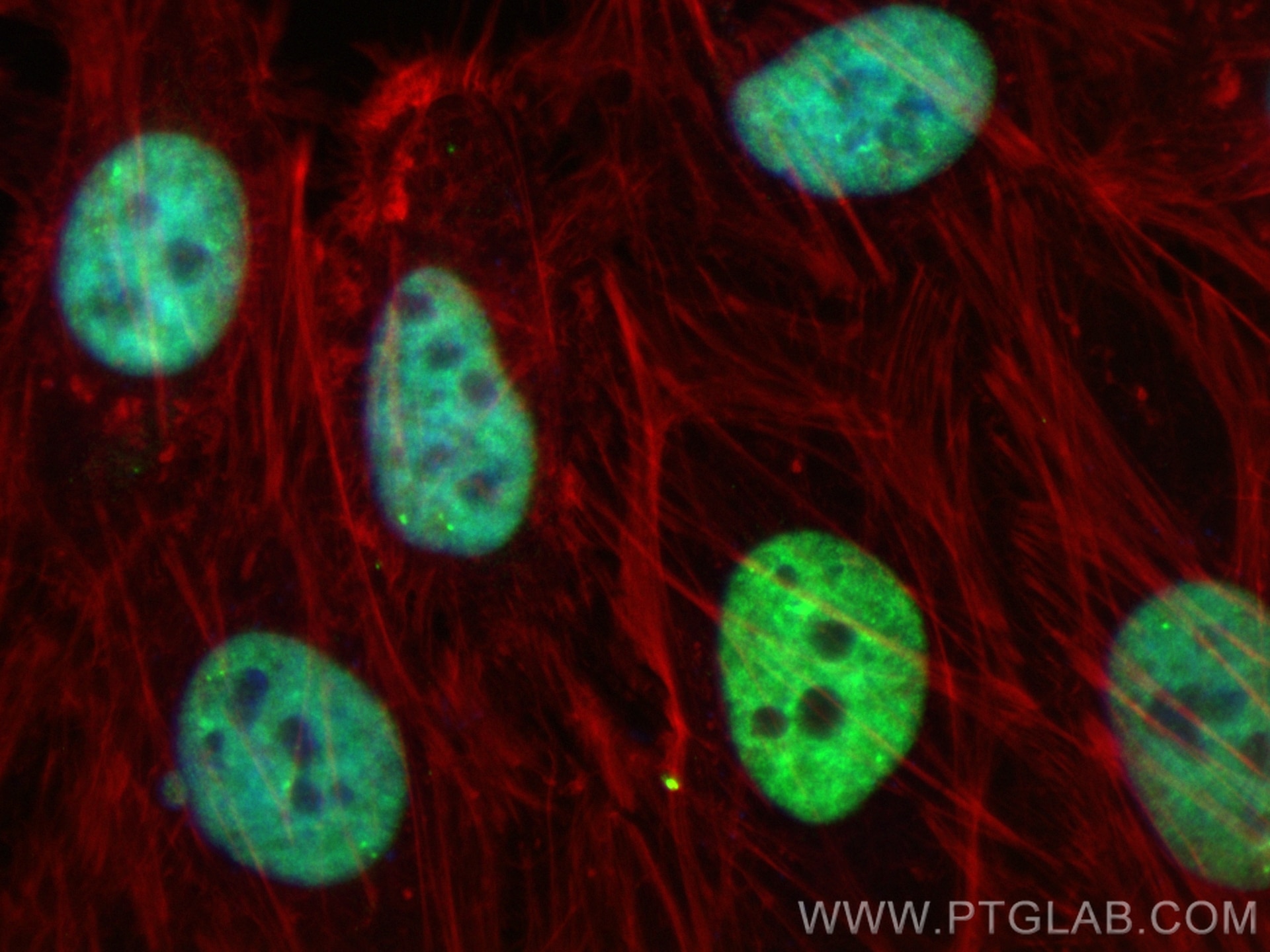
Applications testées
| Résultats positifs en IF/ICC | cellules HeLa, |
Dilution recommandée
| Application | Dilution |
|---|---|
| Immunofluorescence (IF)/ICC | IF/ICC : 1:50-1:500 |
| It is recommended that this reagent should be titrated in each testing system to obtain optimal results. | |
| Sample-dependent, check data in validation data gallery | |
Informations sur le produit
CL488-84329 cible Di/Tri-Methyl-Histone H3 (Lys36) dans les applications de IF/ICC et montre une réactivité avec des échantillons Humain
| Réactivité | Humain |
| Hôte / Isotype | Lapin / IgG |
| Clonalité | Recombinant |
| Type | Anticorps |
| Immunogène | Peptide |
| Nom complet | histone cluster 1, H3a |
| Poids moléculaire observé | 15 kDa |
| Numéro d’acquisition GenBank | BC066245 |
| Symbole du gène | HIST1H3A |
| Identification du gène (NCBI) | 8350 |
| Conjugaison | CoraLite® Plus 488 Fluorescent Dye |
| Excitation/Emission maxima wavelengths | 493 nm / 522 nm |
| Forme | Liquide |
| Méthode de purification | Purification par protéine A |
| Tampon de stockage | PBS with 50% glycerol, 0.05% Proclin300, 0.5% BSA |
| Conditions de stockage | Stocker à -20 °C. Éviter toute exposition à la lumière. Stable pendant un an après l'expédition. L'aliquotage n'est pas nécessaire pour le stockage à -20oC Les 20ul contiennent 0,1% de BSA. |
Informations générales
Histones are small, highly basic proteins that consist of a globular domain with unstructured N- and C-terminal tails protruding from the main structure. Histone H3 is one of the five main histones that are responsible for the nucleosome structure of the chromosomal fiber in eukaryotes. Two molecules of each of the four core histones (H2A, H2B, H3, and H4) form an octamer, around which approximately 146 bp of DNA is wrapped in repeating units, called nucleosomes. In addition to their role in DNA compartmentalization, histones also play crucial roles in various biologic processes, including gene expression and regulation, DNA repair, chromatin condensation, cell cycle progression, chromosome segregation, and apoptosis. The ability of histones to regulate chromatin dynamics primarily originates from various posttranslational modifications carried out by histone-modifying enzymes.
Protocole
| Product Specific Protocols | |
|---|---|
| IF protocol for CL Plus 488 Di/Tri-Methyl-Histone H3 (Lys36) antibody CL488-84329 | Download protocol |
| Standard Protocols | |
|---|---|
| Click here to view our Standard Protocols |

