Anticorps Polyclonal de lapin anti-ERCC8
ERCC8 Polyclonal Antibody for WB, Indirect ELISA
Hôte / Isotype
Lapin / IgG
Réactivité testée
Humain, souris
Applications
WB, Indirect ELISA
Conjugaison
Non conjugué
N° de cat : 15921-1-PBS
Synonymes
Galerie de données de validation
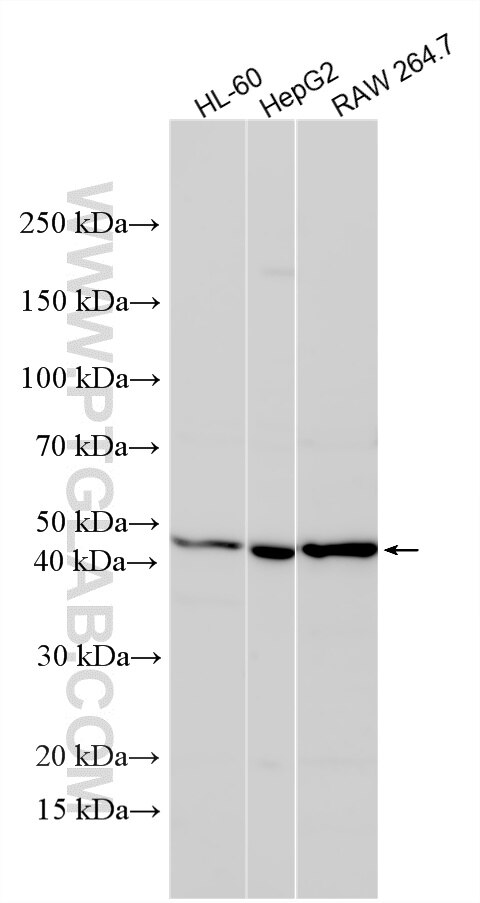
Informations sur le produit
15921-1-PBS cible ERCC8 dans les applications de WB, Indirect ELISA et montre une réactivité avec des échantillons Humain, souris
| Réactivité | Humain, souris |
| Hôte / Isotype | Lapin / IgG |
| Clonalité | Polyclonal |
| Type | Anticorps |
| Immunogène | ERCC8 Protéine recombinante Ag8734 |
| Nom complet | excision repair cross-complementing rodent repair deficiency, complementation group 8 |
| Masse moléculaire calculée | 396 aa, 44 kDa |
| Poids moléculaire observé | 42 kDa |
| Numéro d’acquisition GenBank | BC009793 |
| Symbole du gène | ERCC8 |
| Identification du gène (NCBI) | 1161 |
| Conjugaison | Non conjugué |
| Forme | Liquide |
| Méthode de purification | Purification par affinité contre l'antigène |
| Tampon de stockage | PBS only |
| Conditions de stockage | Store at -80°C. 20ul contiennent 0,1% de BSA. |
Informations générales
ERCC8 (also known as Cockayne Syndrome A protein, CSA) is a critical nuclear protein that serves as a specific adapter component of the CRL4ᴱᴿᶜᶜ⁸ ubiquitin ligase complex. Its primary function is to play a central role in the transcription-coupled nucleotide excision repair pathway, specifically recognizing and repairing the template strands of actively transcribed genes damaged by factors such as ultraviolet radiation. Mutations in the ERCC8 gene cause Cockayne syndrome, an autosomal recessive disorder characterized by severe photosensitivity, premature aging, neurodevelopmental abnormalities, and sensorineural hearing loss. This demonstrates that ERCC8 is essential for maintaining transcriptional fidelity, neuronal survival, and combating oxidative stress. Therefore, ERCC8 is not only a key factor in DNA repair but also an important molecule for studying mechanisms of premature aging and neurobiology.


