- Phare
- Validé par KD/KO
Anticorps Polyclonal de lapin anti-EXOC1
EXOC1 Polyclonal Antibody for IF/ICC
Hôte / Isotype
Lapin / IgG
Réactivité testée
Humain, rat, souris
Applications
IF/ICC
Conjugaison
CoraLite® Plus 488 Fluorescent Dye
N° de cat : CL488-11690
Synonymes
Galerie de données de validation
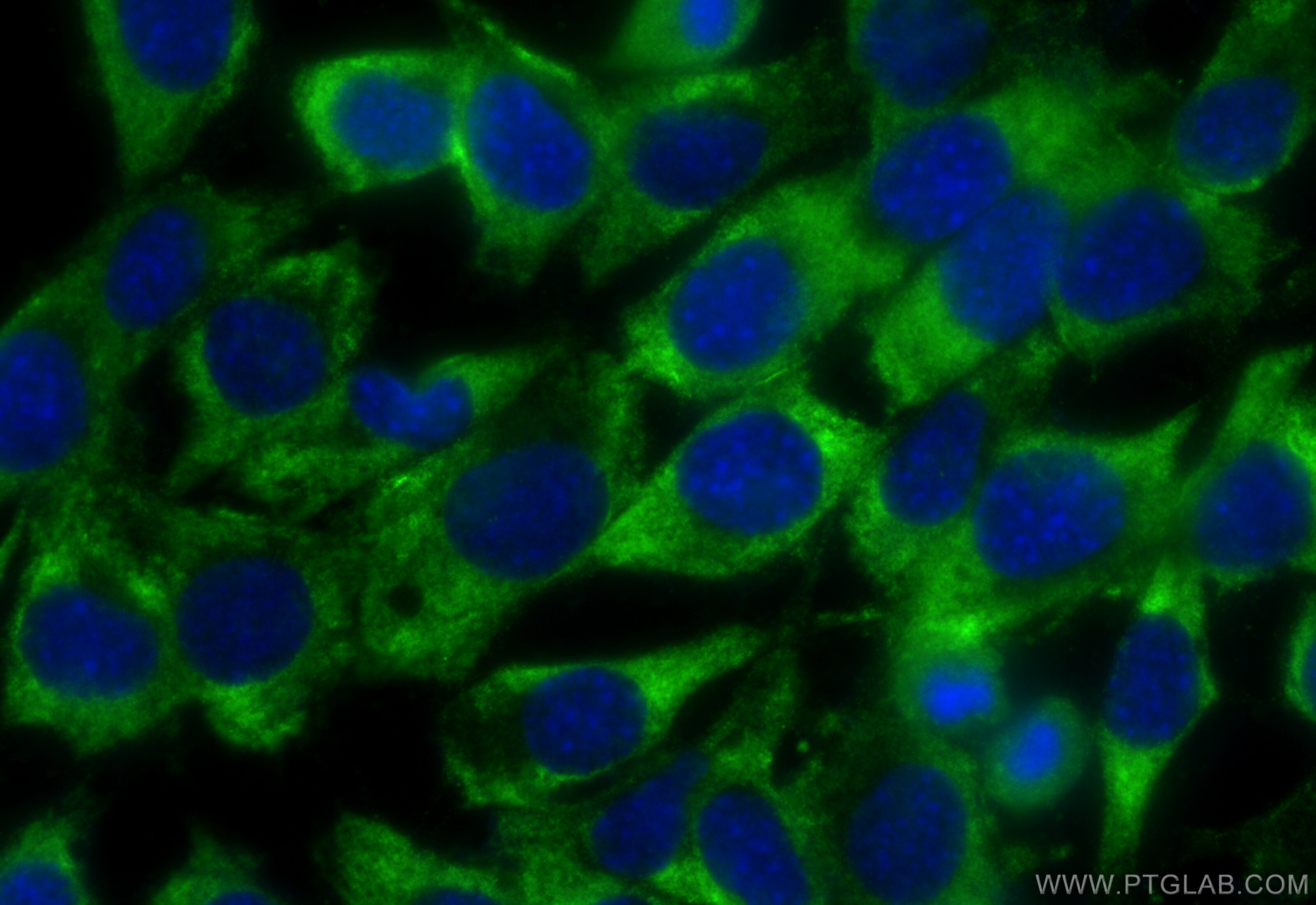
Applications testées
| Résultats positifs en IF/ICC | cellules C2C12, |
Dilution recommandée
| Application | Dilution |
|---|---|
| Immunofluorescence (IF)/ICC | IF/ICC : 1:50-1:500 |
| It is recommended that this reagent should be titrated in each testing system to obtain optimal results. | |
| Sample-dependent, check data in validation data gallery | |
Informations sur le produit
CL488-11690 cible EXOC1 dans les applications de IF/ICC et montre une réactivité avec des échantillons Humain, rat, souris
| Réactivité | Humain, rat, souris |
| Hôte / Isotype | Lapin / IgG |
| Clonalité | Polyclonal |
| Type | Anticorps |
| Immunogène | EXOC1 Protéine recombinante Ag2303 |
| Nom complet | exocyst complex component 1 |
| Masse moléculaire calculée | 894 aa, 102 kDa |
| Poids moléculaire observé | 102 kDa |
| Numéro d’acquisition GenBank | BC020650 |
| Symbole du gène | EXOC1 |
| Identification du gène (NCBI) | 55763 |
| Conjugaison | CoraLite® Plus 488 Fluorescent Dye |
| Excitation/Emission maxima wavelengths | 493 nm / 522 nm |
| Forme | Liquide |
| Méthode de purification | Purification par affinité contre l'antigène |
| Tampon de stockage | PBS with 50% glycerol, 0.05% Proclin300, 0.5% BSA |
| Conditions de stockage | Stocker à -20 °C. Éviter toute exposition à la lumière. Stable pendant un an après l'expédition. L'aliquotage n'est pas nécessaire pour le stockage à -20oC Les 20ul contiennent 0,1% de BSA. |
Informations générales
EXOC1 (exocyst complex component 1), also known as SEC3, is a component of the exocyst complex which is essential for the targeting of exocytic vesicles to specific docking sites on the plasma membrane. The exocyst complex is an octameric complex that tethers vesicles at the plasma membrane, regulates polarized exocytosis, and recruits membranes and proteins required for nanotube formation.Recently it has been reported that exocyst complex proteins are likely a key effector of Nef-mediated enhancement of nanotube formation, and possibly microvesicle secretion, which suggests a new paradigm of exocyst involvement in polarized targeting for intercellular transfer of viral proteins and viruses.
Protocole
| Product Specific Protocols | |
|---|---|
| IF protocol for CL Plus 488 EXOC1 antibody CL488-11690 | Download protocol |
| Standard Protocols | |
|---|---|
| Click here to view our Standard Protocols |

