Anticorps Polyclonal de lapin anti-FAM83H
FAM83H Polyclonal Antibody for WB, Indirect ELISA
Hôte / Isotype
Lapin / IgG
Réactivité testée
Humain
Applications
WB, Indirect ELISA
Conjugaison
Non conjugué
N° de cat : 31974-1-PBS
Synonymes
Galerie de données de validation
Informations sur le produit
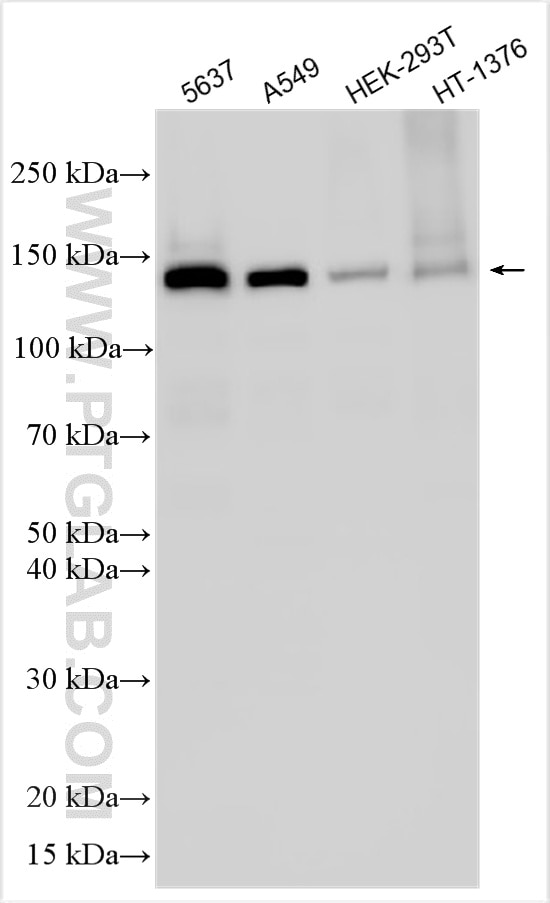
31974-1-PBS cible FAM83H dans les applications de WB, Indirect ELISA et montre une réactivité avec des échantillons Humain
| Réactivité | Humain |
| Hôte / Isotype | Lapin / IgG |
| Clonalité | Polyclonal |
| Type | Anticorps |
| Immunogène | FAM83H Protéine recombinante Ag37139 |
| Nom complet | family with sequence similarity 83, member H |
| Masse moléculaire calculée | 127 kDa |
| Poids moléculaire observé | 140 kDa |
| Numéro d’acquisition GenBank | BC033256 |
| Symbole du gène | FAM83H |
| Identification du gène (NCBI) | 286077 |
| Conjugaison | Non conjugué |
| Forme | Liquide |
| Méthode de purification | Purification par affinité contre l'antigène |
| Tampon de stockage | PBS only |
| Conditions de stockage | Store at -80°C. 20ul contiennent 0,1% de BSA. |
Informations générales
FAM83H was first discovered during extensive computational analysis of the human genomic sequence [PMID: 18252228] and reported to be essential in dental enamel formation [PMID: 26142250, PMID: 21127961]. Mutation of FAM83H is the main etiological factor for human autosomal dominant hypocalcified amelogenesis imperfecta. Moreover, recently, research into FAM83H has focused on its roles in the development and progression of human cancers. However, there are controversial reports for the role of FAM83H in human cancers. Earlier reports, which used microarray analysis, showed higher FAM83H expression in ovarian cancers compared with normal ovarian tissue [PMID: 21617380]. In addition, higher expression of the FAM83H gene is presented in the cancers of lung, breast, colon, liver, ovary, pancreas, and stomach [PMID: 28078827]. The roles of FAM83H in the progression of human cancers involve changes in the proliferation and invasiveness of cancer cells. In colon cancer cells, overexpression of FAM83H is suggested to be involved in the progression of cancer cells by disorganizing keratin cytoskeleton structures [PMID: 23902688, PMID: 27681590]. In addition, FAM83H increases proliferation of prostatic cancer cells [PMID: 26512949], hepatocellular carcinoma cells [PMID: 28607447], and clear cell renal cell carcinoma cells [PMID: 30723706]. In hepatocellular carcinoma cells, activation of the MYC-FAM83H pathway increases the proliferation and invasion activity of cancer cells [PMID: 28607447]. Moreover, higher expression of FAM83H is associated with an increased recurrence rate of prostatic cancer patients and shorter survival of uterine cancer [PMID: 28078827], hepatocellular carcinoma [PMID: 28607447], and clear cell renal cell carcinoma patients [PMID: 21057535]. These findings suggest that FAM83H has a vital role in tumorigenesis and progression of human malignant tumors, and might be involved in the progression of various types of human cancers. However, the expression of FAM83H is down-regulated in astrocytoma and oligodendroglioma of the brain, and higher expression of FAM83H is associated with favorable prognosis of glioma and head and neck cancer patients [PMID: 28078827]. Therefore, there is a possibility that the role of FAM83H might be different according to the type of cells and further study is needed [PMID: 21057535].


