Anticorps Polyclonal de lapin anti-FANK1
FANK1 Polyclonal Antibody for WB, Indirect ELISA
Hôte / Isotype
Lapin / IgG
Réactivité testée
Humain, rat, souris
Applications
WB, Indirect ELISA
Conjugaison
Non conjugué
N° de cat : 17167-1-PBS
Synonymes
Galerie de données de validation
Informations sur le produit
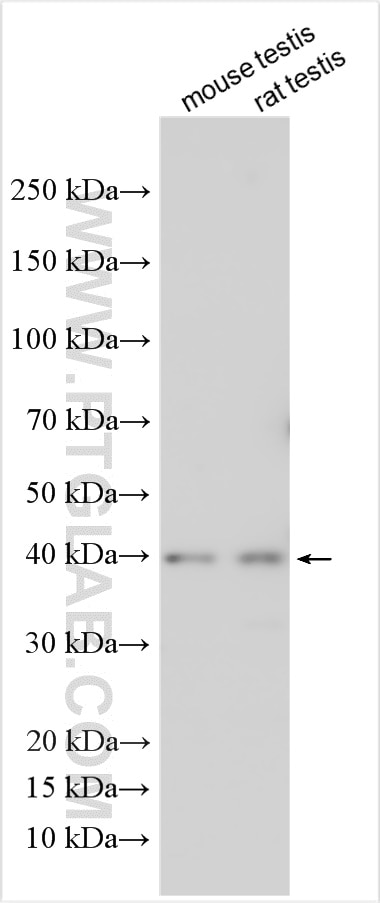
17167-1-PBS cible FANK1 dans les applications de WB, Indirect ELISA et montre une réactivité avec des échantillons Humain, rat, souris
| Réactivité | Humain, rat, souris |
| Hôte / Isotype | Lapin / IgG |
| Clonalité | Polyclonal |
| Type | Anticorps |
| Immunogène | FANK1 Protéine recombinante Ag10639 |
| Nom complet | fibronectin type III and ankyrin repeat domains 1 |
| Masse moléculaire calculée | 345 aa, 38 kDa |
| Poids moléculaire observé | 38-40 kDa |
| Numéro d’acquisition GenBank | BC024189 |
| Symbole du gène | FANK1 |
| Identification du gène (NCBI) | 92565 |
| Conjugaison | Non conjugué |
| Forme | Liquide |
| Méthode de purification | Purification par affinité contre l'antigène |
| Tampon de stockage | PBS only |
| Conditions de stockage | Store at -80°C. 20ul contiennent 0,1% de BSA. |
Informations générales
FANK1 (Fibronectin type 3 and ankyrin repeat domains protein 1), also known as HSD13. It is expected to be located in the nucleus. And mostly restricted to testis (PMID: 17604233). Fibronectin type III and ankyrin repeat domains 1(Fank1) is a nuclear protein expressed during the transition from the meiotic phase to the haploid phase of spermatogenesis. While little is known about the function of Fank1 during spermatogenesis, gene ontology analysis suggests that it may be a transcription factor. H. Wang explored the role of Fank1 using the yeast two-hybrid system to screen for cellular proteins that may interact with Fank1. In this screen, they identified the Jun activation domain-binding protein 1 (Jab1) as a potential Fank1-interacting protein (PMID: 20978819).


