Anticorps Recombinant de lapin anti-FSTL1
FSTL1 Recombinant Antibody for WB, ELISA
Hôte / Isotype
Lapin / IgG
Réactivité testée
Humain, rat, souris
Applications
WB, ELISA
Conjugaison
Non conjugué
CloneNo.
251240E12
N° de cat : 86444-1-RR
Synonymes
Galerie de données de validation
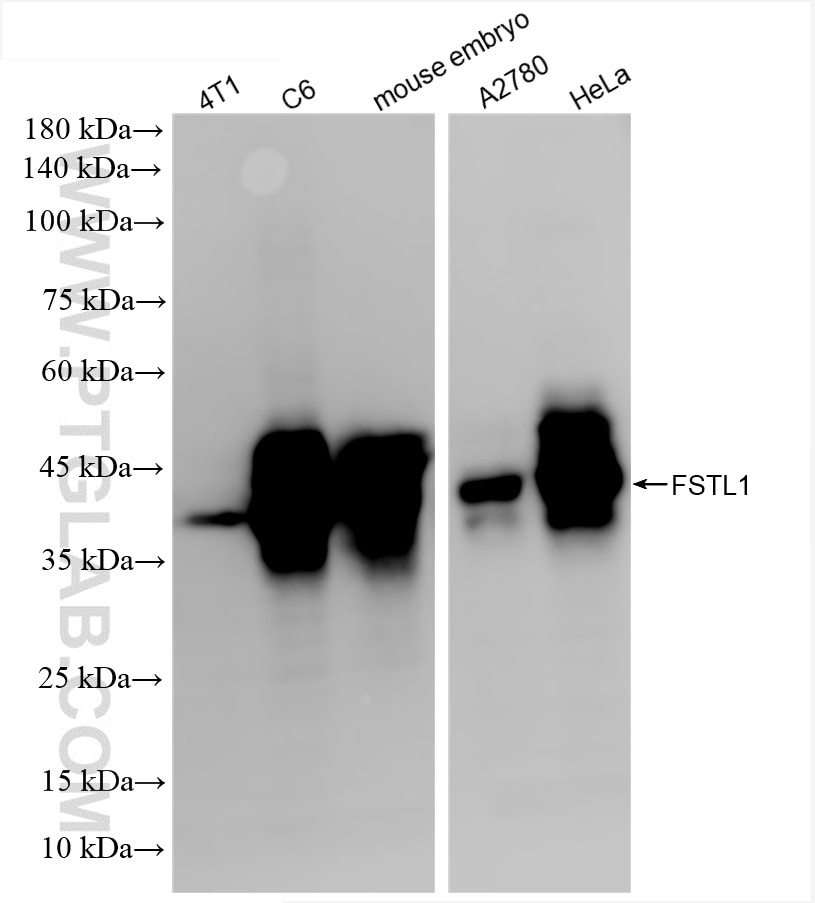
Applications testées
| Résultats positifs en WB | cellules 4T1, cellules A2780, cellules C6, cellules HeLa, tissu embryonnaire de souris |
Dilution recommandée
| Application | Dilution |
|---|---|
| Western Blot (WB) | WB : 1:5000-1:50000 |
| It is recommended that this reagent should be titrated in each testing system to obtain optimal results. | |
| Sample-dependent, check data in validation data gallery | |
Informations sur le produit
86444-1-RR cible FSTL1 dans les applications de WB, ELISA et montre une réactivité avec des échantillons Humain, rat, souris
| Réactivité | Humain, rat, souris |
| Hôte / Isotype | Lapin / IgG |
| Clonalité | Recombinant |
| Type | Anticorps |
| Immunogène | FSTL1 Protéine recombinante Eg2859 |
| Nom complet | follistatin-like 1 |
| Masse moléculaire calculée | 35 kDa |
| Poids moléculaire observé | 35-45 kDa |
| Numéro d’acquisition GenBank | NM_008047.5 |
| Symbole du gène | Fstl1 |
| Identification du gène (NCBI) | 14314 |
| Conjugaison | Non conjugué |
| Forme | Liquide |
| Méthode de purification | Purification par protéine A |
| Tampon de stockage | PBS with 0.02% sodium azide and 50% glycerol |
| Conditions de stockage | Stocker à -20°C. Stable pendant un an après l'expédition. L'aliquotage n'est pas nécessaire pour le stockage à -20oC Les 20ul contiennent 0,1% de BSA. |
Informations générales
Follistatin-like 1 (FSTL1), initially discovered as a TGF-β1-induced gene, encodes a 308 amino acid secreted 45-55 kDa glycoprotein with a follistatin domain and two non-functional calcium-binding motifs. FSTL1 has been reported to be involved in the fate determination and maturation of epithelial cells. Ablation of the FSTL1 gene in the mouse results in several structural developmental defects and neonatal lethality due to respiratory failure, demonstrating its functional importance. FSTL1 has been reported to exhibit both pro- and anti-inflammatory actions, with a specific anti-apoptotic and protective effect in cardiac or renal cell injury. Zwijsen et al. (1994) detected several isoforms of FSTL1 with molecular masses of 40 to 48 kD, which differ from the 50- to 55-kD products detected by Tanaka et al. (1998) (OMIM). (PMID: 26386648; PMID: 23723173; PMID: 20176958).
Protocole
| Product Specific Protocols | |
|---|---|
| WB protocol for FSTL1 antibody 86444-1-RR | Download protocol |
| Standard Protocols | |
|---|---|
| Click here to view our Standard Protocols |

