Anticorps Polyclonal de lapin anti-Fibulin-7
Fibulin-7 Polyclonal Antibody for WB, Indirect ELISA
Hôte / Isotype
Lapin / IgG
Réactivité testée
Humain, porc
Applications
WB, Indirect ELISA
Conjugaison
Non conjugué
N° de cat : 21136-1-PBS
Synonymes
Galerie de données de validation
Informations sur le produit
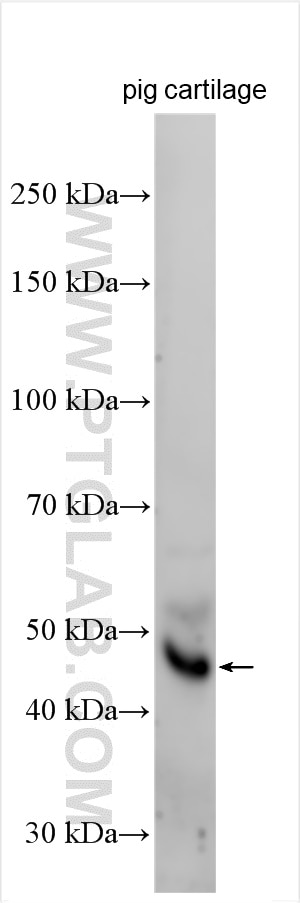
21136-1-PBS cible Fibulin-7 dans les applications de WB, Indirect ELISA et montre une réactivité avec des échantillons Humain, porc
| Réactivité | Humain, porc |
| Hôte / Isotype | Lapin / IgG |
| Clonalité | Polyclonal |
| Type | Anticorps |
| Immunogène | Fibulin-7 Protéine recombinante Ag15564 |
| Nom complet | fibulin 7 |
| Masse moléculaire calculée | 439 aa, 47 kDa |
| Poids moléculaire observé | 47 kDa |
| Numéro d’acquisition GenBank | BC035784 |
| Symbole du gène | Fibulin-7 |
| Identification du gène (NCBI) | 129804 |
| Conjugaison | Non conjugué |
| Forme | Liquide |
| Méthode de purification | Purifié par affinité contre l'antigène |
| Tampon de stockage | PBS only |
| Conditions de stockage | Store at -80°C. 20ul contiennent 0,1% de BSA. |
Informations générales
Fibulins are a family of extracellular matrix glycoproteins associated with basement membranes, elastic fibers, and other matrices (PMID: 19189051). The family members are defined by the presence of two structural modules, a tandem repeat of epidermal growth factor-like modules, and a unique C-terminal fibulin-type module (PMID: 19189051). They play an important role in regulating multiple cellular functions such as adhesion, growth, motility, and survival (PMID: 32429873). Fibulin-7, also named as TM14, was first identified in the mouse tooth germ cDNA microarray by differential hybridization (PMID: 17699513). Fibulin-7 is expressed in developing odontoblasts, in the giant trophoblast layer of the placenta, in the choroid of the eyes as well as in the cartilage (PMID: 32429873). It plays important roles in both the differentiation and maintenance of odontoblasts as well as in dentin formation.


