- Phare
- Validé par KD/KO
Anticorps Polyclonal de lapin anti-GLAST/EAAT1
GLAST/EAAT1 Polyclonal Antibody for IHC
Hôte / Isotype
Lapin / IgG
Réactivité testée
Humain, rat, souris
Applications
IHC
Conjugaison
Biotin
N° de cat : Biotin-20785
Synonymes
Galerie de données de validation
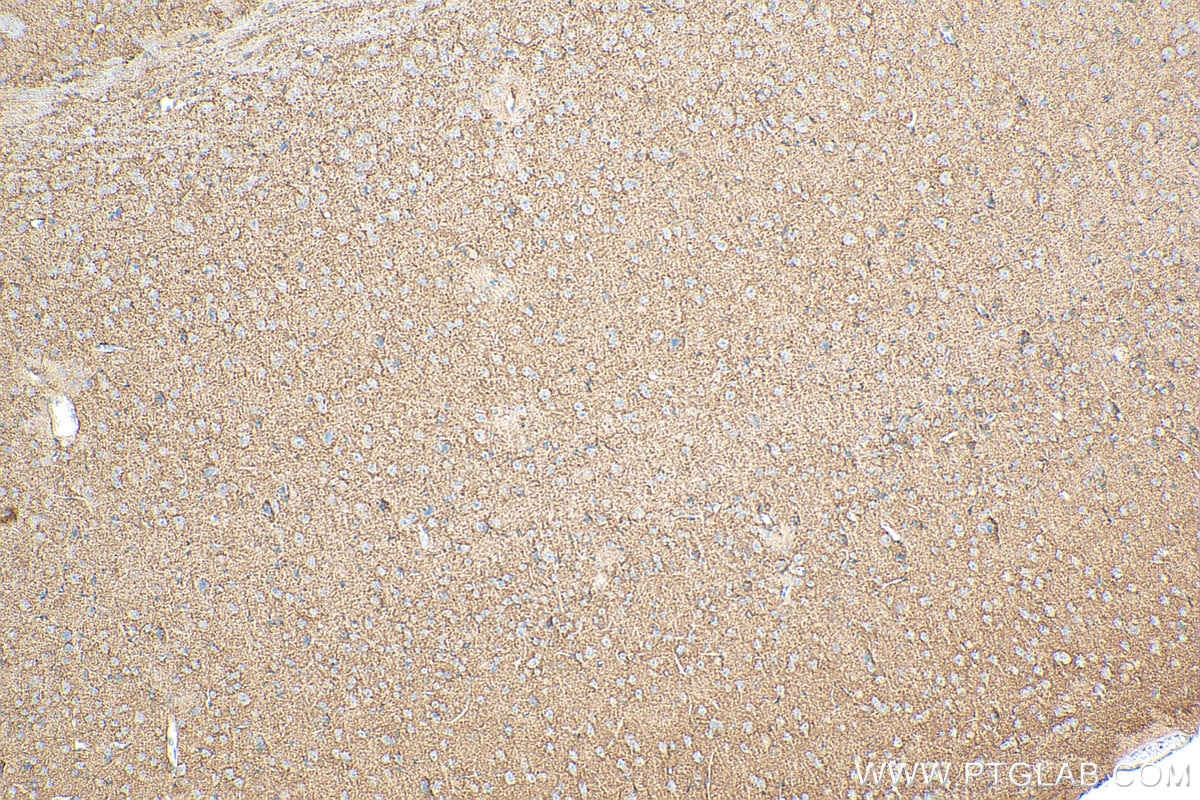
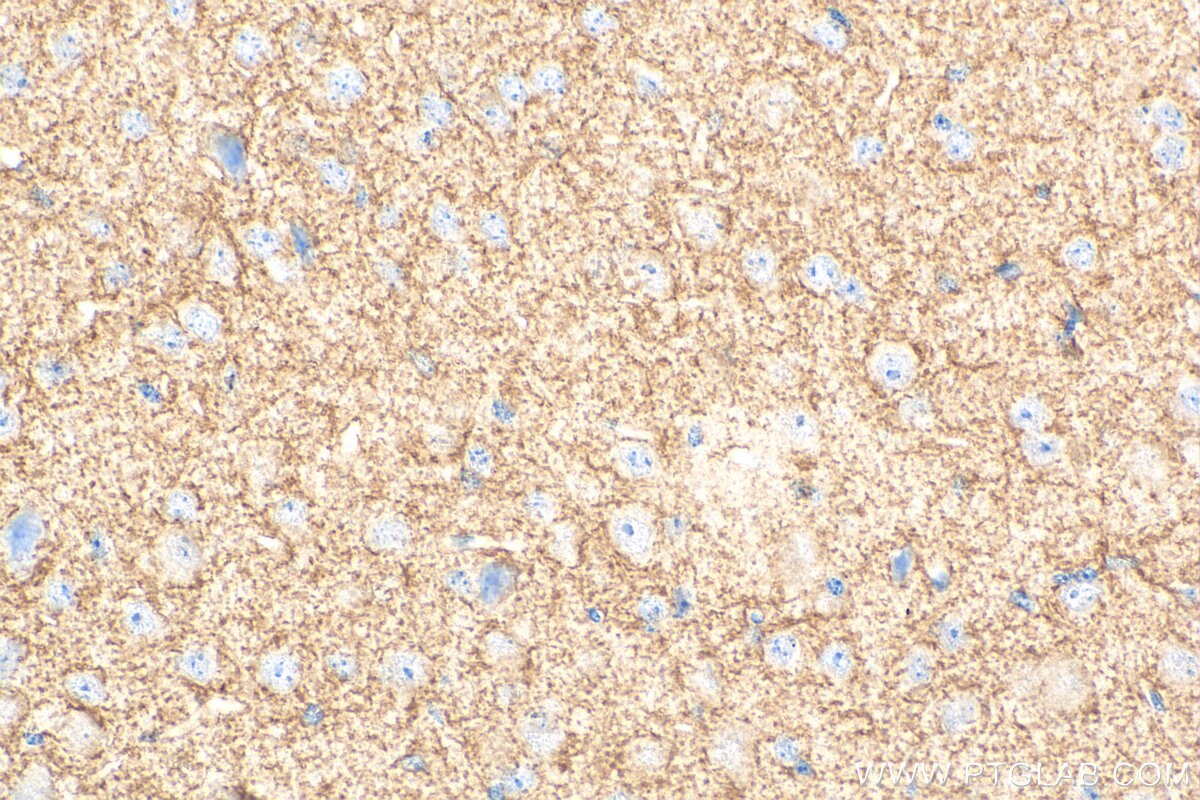
Applications testées
| Résultats positifs en IHC | tissu cérébral de souris, il est suggéré de démasquer l'antigène avec un tampon de TE buffer pH 9.0; (*) À défaut, 'le démasquage de l'antigène peut être 'effectué avec un tampon citrate pH 6,0. |
Dilution recommandée
| Application | Dilution |
|---|---|
| Immunohistochimie (IHC) | IHC : 1:50-1:500 |
| It is recommended that this reagent should be titrated in each testing system to obtain optimal results. | |
| Sample-dependent, check data in validation data gallery | |
Informations sur le produit
Biotin-20785 cible GLAST/EAAT1 dans les applications de IHC et montre une réactivité avec des échantillons Humain, rat, souris
| Réactivité | Humain, rat, souris |
| Hôte / Isotype | Lapin / IgG |
| Clonalité | Polyclonal |
| Type | Anticorps |
| Immunogène | GLAST/EAAT1 Protéine recombinante Ag14177 |
| Nom complet | solute carrier family 1 (glial high affinity glutamate transporter), member 3 |
| Masse moléculaire calculée | 542 aa, 60 kDa |
| Poids moléculaire observé | 50-55 kDa, 90-100 kDa |
| Numéro d’acquisition GenBank | BC037310 |
| Symbole du gène | GLAST |
| Identification du gène (NCBI) | 6507 |
| Conjugaison | Biotin |
| Forme | Liquide |
| Méthode de purification | Purification par affinité contre l'antigène |
| Tampon de stockage | PBS with 50% glycerol, 0.05% Proclin300, 0.5% BSA |
| Conditions de stockage | Stocker à -20 °C. Éviter toute exposition à la lumière. Stable pendant un an après l'expédition. L'aliquotage n'est pas nécessaire pour le stockage à -20oC Les 20ul contiennent 0,1% de BSA. |
Informations générales
SLC1A3, also known as EAAT-1 or GLAST, is a membrane-bound protein localized in glial cells and pre-synaptic glutamatergic nerve endings. It transports the excitatory neurotransmitters L-glutamate and D-aspartate, which is essential for terminating the postsynaptic acction of glutamate. Recently, a correlation between expression/function of glial EAAT-1 and tumor proliferation has been reported. The exceptionally rare expression of EAAT-1 in non-neoplastic choroid plexus (CP) compared to choroid plexus tumors (CPT) may distinguishes neoplastic from normal CP. There are a number of splicing variants of SLC1A3, like GLAST1a and GLAST1b, exist due to the exon skipping. It also undergo glycosylation. Variety of bands can be observed in the western blotting assay: 50-55 kDa represents the unglycosylated GLAST1a or GLAST1b, 65-70 kDa correspond to the glycosylated proteins, larger proteins between 90-130 kDa may be the multimers of SLC1A3. (11086157, 17471058, 12546822)
Protocole
| Product Specific Protocols | |
|---|---|
| IHC protocol for Biotin GLAST/EAAT1 antibody Biotin-20785 | Download protocol |
| Standard Protocols | |
|---|---|
| Click here to view our Standard Protocols |

