Anticorps Polyclonal de lapin anti-GLIS3
GLIS3 Polyclonal Antibody for WB, Indirect ELISA
Hôte / Isotype
Lapin / IgG
Réactivité testée
Humain, rat, souris
Applications
WB, Indirect ELISA
Conjugaison
Non conjugué
N° de cat : 12678-1-PBS
Synonymes
Galerie de données de validation
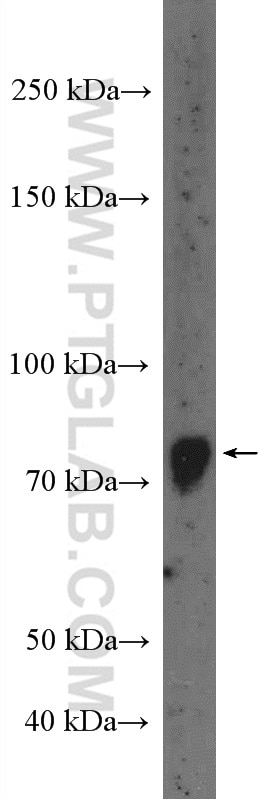
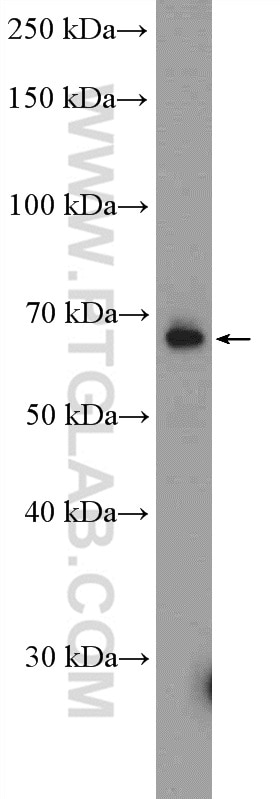
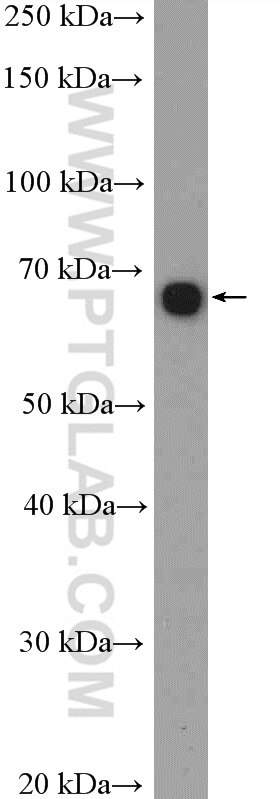
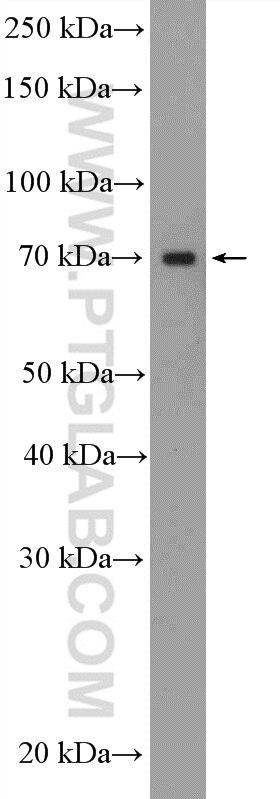
Informations sur le produit
12678-1-PBS cible GLIS3 dans les applications de WB, Indirect ELISA et montre une réactivité avec des échantillons Humain, rat, souris
| Réactivité | Humain, rat, souris |
| Hôte / Isotype | Lapin / IgG |
| Clonalité | Polyclonal |
| Type | Anticorps |
| Immunogène | GLIS3 Protéine recombinante Ag3366 |
| Nom complet | GLIS family zinc finger 3 |
| Masse moléculaire calculée | 775 aa, 84 kDa |
| Poids moléculaire observé | 70-85 kDa |
| Numéro d’acquisition GenBank | BC033899 |
| Symbole du gène | GLIS3 |
| Identification du gène (NCBI) | 169792 |
| Conjugaison | Non conjugué |
| Forme | Liquide |
| Méthode de purification | Purification par affinité contre l'antigène |
| Tampon de stockage | PBS only |
| Conditions de stockage | Store at -80°C. 20ul contiennent 0,1% de BSA. |
Informations générales
Zinc-finger proteins contain DNA-binding domains and have a wide variety of functions, most of which encompass some form of transcriptional activation or repression. GLIS3 (gLIS family zinc finger 3), also known as ZNF515 that localizes to the nucleus and contains five C2H2-type zinc fingers. Expressed in a variety of tissues, including kidney, brain, liver, lung, ovary, pancreas, thymus and skeletal muscle, GLIS3 functions as both an activator and a suppressor of transcription, specifically binding the consensus sequence 5'-GACCACCCAC-3' through its C2H2-type zinc fingers. Defects in the gene encoding GLIS3 are a cause of NDH syndrome; a neonatal diabetes that is characterized by congenital hypothyroidism, congenital glaucoma, hepatic fibrosis and polycystic kidneys. There are various isoform of GLIS3 and molecular weight of one isoform is 70 kDa.


