Anticorps Polyclonal de lapin anti-Hepsin
Hepsin Polyclonal Antibody for WB, Indirect ELISA
Hôte / Isotype
Lapin / IgG
Réactivité testée
Humain, souris
Applications
WB, Indirect ELISA
Conjugaison
Non conjugué
N° de cat : 51060-1-PBS
Synonymes
Galerie de données de validation
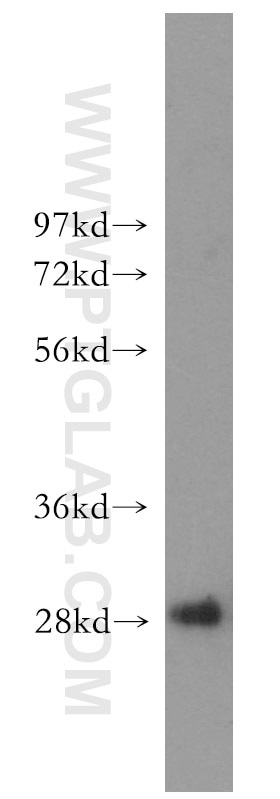
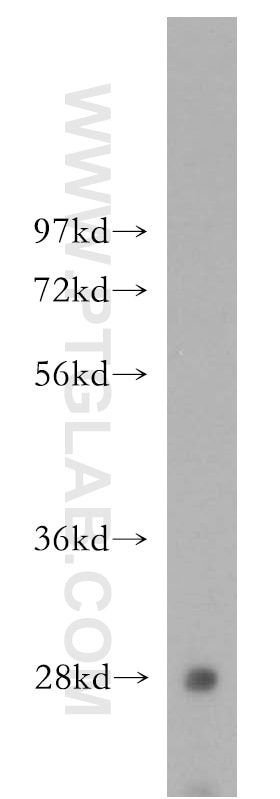
Informations sur le produit
51060-1-PBS cible Hepsin dans les applications de WB, Indirect ELISA et montre une réactivité avec des échantillons Humain, souris
| Réactivité | Humain, souris |
| Hôte / Isotype | Lapin / IgG |
| Clonalité | Polyclonal |
| Type | Anticorps |
| Immunogène | Peptide |
| Nom complet | hepsin |
| Masse moléculaire calculée | 47 kDa |
| Poids moléculaire observé | 28 kDa |
| Numéro d’acquisition GenBank | BC138809 |
| Symbole du gène | Hepsin |
| Identification du gène (NCBI) | 15451 |
| Conjugaison | Non conjugué |
| Forme | Liquide |
| Méthode de purification | Purification par protéine A |
| Tampon de stockage | PBS only |
| Conditions de stockage | Store at -80°C. 20ul contiennent 0,1% de BSA. |
Informations générales
Hepsin is a type II transmembrane serine protease. It is primarily expressed in the liver but has also been detected in other tissues, including the prostate, kidney, and pancreas. Hepsin plays a crucial role in various physiological processes, such as cell growth, extracellular matrix remodeling, and tissue homeostasis. Notably, Hepsin has been implicated in cancer progression, particularly in prostate cancer, where its overexpression is associated with tumor metastasis and poor prognosis (PMID: 15324701, PMID: 18726901). Hepsin has been identified as a peptide of approximately 45 kDa representing the intact protein, and a fragment of about 28 kDa representing the cleaved extracellular domain (PMID: 19302215, PMID: 21734266).


