Anticorps Polyclonal de lapin anti-IL-5
IL-5 Polyclonal Antibody for WB, ELISA
Hôte / Isotype
Lapin / IgG
Réactivité testée
Humain
Applications
WB, ELISA
Conjugaison
Non conjugué
N° de cat : 30416-1-AP
Synonymes
Galerie de données de validation
Filter:
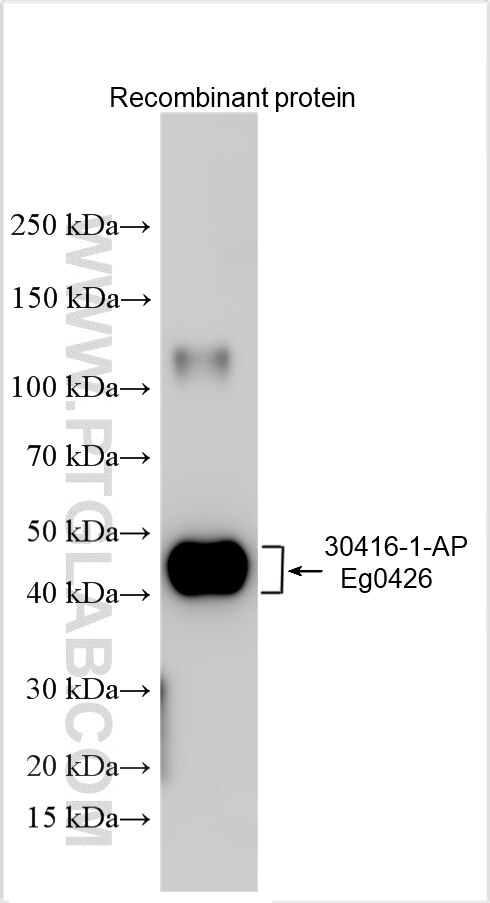
Applications testées
| Résultats positifs en WB | Protéine recombinante, |
Dilution recommandée
| Application | Dilution |
|---|---|
| Western Blot (WB) | WB : 1:1000-1:4000 |
| It is recommended that this reagent should be titrated in each testing system to obtain optimal results. | |
| Sample-dependent, check data in validation data gallery | |
Informations sur le produit
30416-1-AP cible IL-5 dans les applications de WB, ELISA et montre une réactivité avec des échantillons Humain
| Réactivité | Humain |
| Hôte / Isotype | Lapin / IgG |
| Clonalité | Polyclonal |
| Type | Anticorps |
| Immunogène | IL-5 Protéine recombinante Eg0380 |
| Nom complet | interleukin 5 (colony-stimulating factor, eosinophil) |
| Masse moléculaire calculée | 134 aa, 15 kDa |
| Numéro d’acquisition GenBank | BC066282 |
| Symbole du gène | IL5 |
| Identification du gène (NCBI) | 3567 |
| Conjugaison | Non conjugué |
| Forme | Liquide |
| Méthode de purification | Purification par affinité contre l'antigène |
| Tampon de stockage | PBS with 0.02% sodium azide and 50% glycerol |
| Conditions de stockage | Stocker à -20°C. Stable pendant un an après l'expédition. L'aliquotage n'est pas nécessaire pour le stockage à -20oC Les 20ul contiennent 0,1% de BSA. |
Informations générales
Interleukin-5 (IL-5) is a pleiotropic cytokine primarily produced by activated T helper 2 (Th2) cells, mast cells, and group 2 innate lymphoid cells (ILC2s). It plays a critical role in the regulation of eosinophil proliferation, differentiation, and activation, making it a key mediator in allergic inflammation, parasitic infections, and certain autoimmune diseases.
Protocole
| Product Specific Protocols | |
|---|---|
| WB protocol for IL-5 antibody 30416-1-AP | Download protocol |
| Standard Protocols | |
|---|---|
| Click here to view our Standard Protocols |

