Anticorps Polyclonal de lapin anti-IL-17RA
IL-17RA Polyclonal Antibody for WB, ELISA
Hôte / Isotype
Lapin / IgG
Réactivité testée
Humain
Applications
WB, ELISA
Conjugaison
Non conjugué
N° de cat : 32055-1-AP
Synonymes
Galerie de données de validation
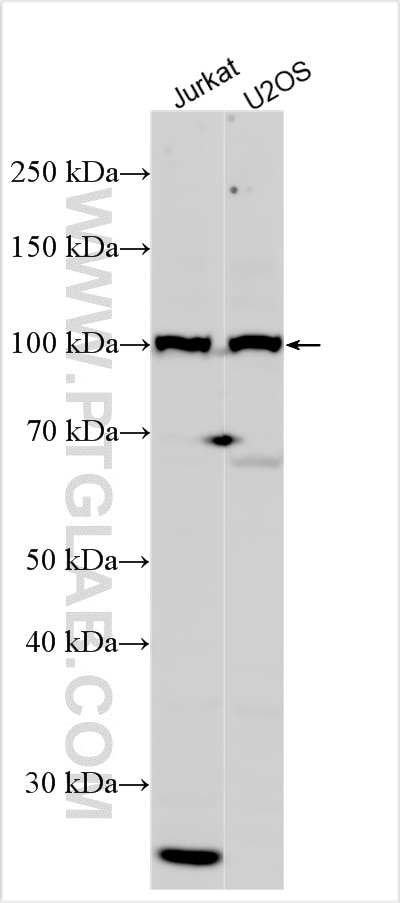
Applications testées
| Résultats positifs en WB | cellules Jurkat, cellules U2OS |
Dilution recommandée
| Application | Dilution |
|---|---|
| Western Blot (WB) | WB : 1:500-1:3000 |
| It is recommended that this reagent should be titrated in each testing system to obtain optimal results. | |
| Sample-dependent, check data in validation data gallery | |
Informations sur le produit
32055-1-AP cible IL-17RA dans les applications de WB, ELISA et montre une réactivité avec des échantillons Humain
| Réactivité | Humain |
| Hôte / Isotype | Lapin / IgG |
| Clonalité | Polyclonal |
| Type | Anticorps |
| Immunogène | IL-17RA Protéine recombinante Eg2317 |
| Nom complet | interleukin 17 receptor A |
| Masse moléculaire calculée | 866 aa, 96 kDa |
| Poids moléculaire observé | 100 kDa |
| Numéro d’acquisition GenBank | BC011624 |
| Symbole du gène | IL17RA |
| Identification du gène (NCBI) | 23765 |
| Conjugaison | Non conjugué |
| Forme | Liquide |
| Méthode de purification | Purification par affinité contre l'antigène |
| Tampon de stockage | PBS with 0.02% sodium azide and 50% glycerol |
| Conditions de stockage | Stocker à -20°C. Stable pendant un an après l'expédition. L'aliquotage n'est pas nécessaire pour le stockage à -20oC Les 20ul contiennent 0,1% de BSA. |
Informations générales
Interleukin-17 receptor A (IL17A) is a major effector cytokine of the innate and adaptive immune system and is involved in antimicrobial host defense and maintenance of tissue integrity. It has been shown that IL-17A is involved in the pathogenesis of asthma and allergy and regulates local immune and inflammatory processes in bone tissue and is involved in the onset and progression of osteoporosis. In addition to this, due to polymorphisms in the IL17RA gene, it leads to the development of Fanconi anemia.
Protocole
| Product Specific Protocols | |
|---|---|
| WB protocol for IL-17RA antibody 32055-1-AP | Download protocol |
| Standard Protocols | |
|---|---|
| Click here to view our Standard Protocols |

